Bernd Biervert examines the future of EU trade policy and strategic dependencies
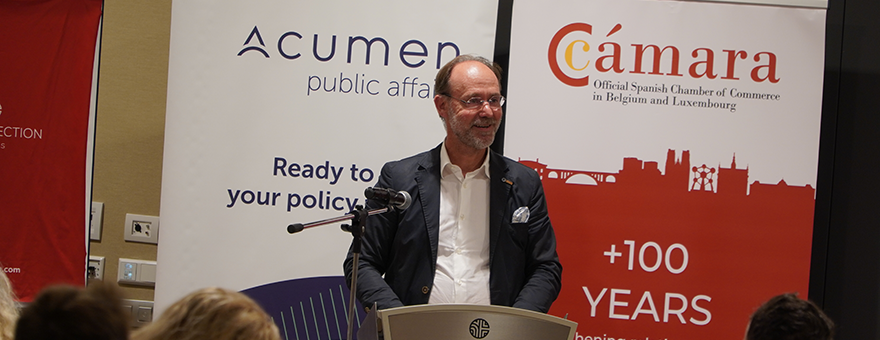
The Official Spanish Chamber of Commerce in Belgium and Luxembourg held on Tuesday 15 September, as part of its Círculo de Negocios forum, a luncheon debate with Bernd Biervert, Head of Cabinet to Maroš Šefčovič, European Commissioner for Trade and Economic Security, on “Strategic dependencies: the future of EU trade policy”. The event was held in English, with the sponsorship of Acumen Public Affairs.
The luncheon opened with the introduction of the speaker by the President of the Chamber, Pablo López Álvarez, who outlined his career at the European Commission, and with a short intervention by Nicolás Fuentes Colomer, Associate Director – Environment at Acumen Public Affairs, the event’s sponsor, who framed trade as the crossroads of most of today’s economic debates.
The session started from the geopolitical and geo-economic context in which European trade policy now operates, and the balance it demands: maintaining the openness agenda while responding to those challenges through industrial policy and protecting the productive base. It reviewed the state of the trade agreement agenda, with the Mercosur agreement pending ratification, Indonesia at signature stage and negotiations under way with the Philippines, Malaysia and the Gulf region, and presented that agenda as a diversification policy: securing access to critical raw materials and reducing dependencies that, in the current context, can end up being weaponised.
Narrower agreements and more active trade defence
One thread of the discussion was the length of trade negotiations and the need to explore narrower, faster formats than the classic comprehensive agreements, such as the clean trade and investment partnership tested with South Africa. Another was trade defence instruments — anti-dumping, anti-subsidy and the safeguards activated recently —, their application in line with World Trade Organization rules, and the open debate on how to treat the closest partners. It was also noted that trade policy cannot carry European competitiveness on its own: completing the single market was presented as a lever of equivalent effect, given that the internal barriers still in place are equivalent to tariffs.
The part devoted to Spain highlighted the close cooperation with the Spanish authorities and companies and the country’s support for the European trade agenda, with offensive interests in sectors such as textiles, machinery and ceramics, and particular attention to geographical indications and the agricultural chapter. The question and answer round took up the second half of the event and covered measures on scrap metal exports, reciprocity in public procurement and the integration of European value chains, how the economic security instruments fit together, carbon pricing, and market access for exporting sectors such as spirits.
The Chamber thanks Bernd Biervert for taking part in this Círculo de Negocios session and for the time he devoted to answering attendees’ questions, as well as Acumen Public Affairs for its sponsorship and Bodegas Ayuso for the wines that accompanied the lunch.
Sponsored by:

Wine sponsored by: