
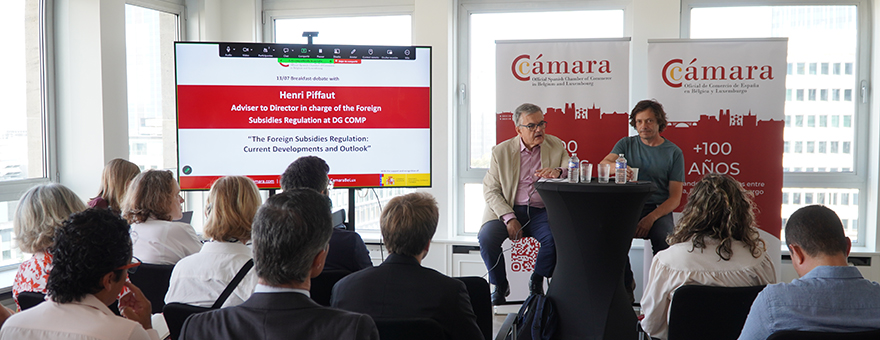
Henri Piffaut discusses the evolution of the Foreign Subsidies Regulation and the challenges involved in its implementation within the EU
The Official Spanish Chamber of Commerce in Belgium and Luxembourg held a breakfast debate last Monday, 13 July, as part of its ‘Competencia España’ working group and its ‘Business Circle’ forum, a breakfast debate featuring Henri Piffaut, adviser to the Director responsible for the Foreign Subsidies Regulation (FSR) at the European Commission’s Directorate-General for Competition (DG COMP). During the event, the speaker analysed the development and impact of this new European instrument for monitoring competition within the single market, as well as the main challenges arising from its entry into force in 2023.
The event began with the introduction of Mr Piffaut by the president of Competencia España, Cecilio Madero, who welcomed the attendees and outlined the speaker’s professional background, highlighting his experience in advising on the development of European policy regarding foreign subsidies, as well as on the interpretation and application of the Regulation within DG COMP.
During the session, the group analysed how the Foreign Subsidies Regulation introduces a specific instrument to examine the economic advantages granted by third countries to European Union companies and to assess whether they may cause distortions in the internal market.
Fair competition
The debate highlighted that the aim of the CSR is not to restrict foreign investment, but to ensure a level playing field within the single market. During the session, the main areas of application were reviewed, covering business concentrations, public procurement and ex officio investigations; as well as the importance of the guidelines published by the Commission in January 2026 to strengthen legal certainty and promote a consistent application of the Regulation.
Among the main challenges identified, the need to strike a balance between effective oversight and the administrative burden that certain procedures may entail was highlighted. In this regard, the discussion addressed the improvement of processes such as pre-notification, drawing on the first decisions issued by the Commission under the new regime in transactions involving investors from the Gulf region.
During the question-and-answer session, the concept of distortion was analysed, along with the criteria used to determine whether a foreign subsidy may affect the internal market, taking into account both the improvement in the beneficiary company’s competitive position and its potential effects on competition. The balancing test was also discussed, which allows the negative effects of a subsidy to be weighed against its potential positive effects.
The session concluded with a discussion on the international scope of the RSE, its relationship with other competition instruments, and the challenge of striking a balance between economic openness, attracting foreign investment and safeguarding effective competition within the European Union.
An event by:
