Pilar Sáenz de Ormijana takes stock of the negotiations on the 2028-2034 Multiannual Financial Framework
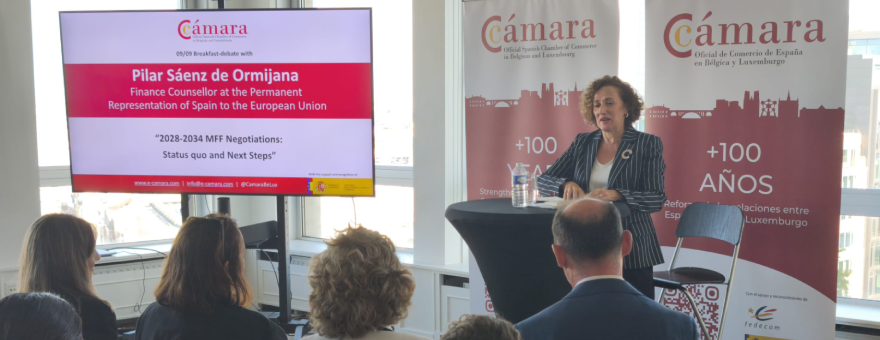
The Official Spanish Chamber of Commerce in Belgium and Luxembourg held on Wednesday 9 September, as part of its Círculo de Negocios forum, a breakfast debate with Pilar Sáenz de Ormijana, Finance Counsellor at the Permanent Representation of Spain to the European Union, on the state of play of the negotiations on the 2028-2034 Multiannual Financial Framework (MFF) and the steps expected over the coming months. The session was held in English at the Chamber’s premises in Brussels.
The breakfast debate opened with the introduction of the speaker by the President of the Chamber, Pablo López Álvarez, who welcomed attendees and outlined her career at the Permanent Representation and her role in following the European budget negotiations.
The session reviewed the architecture of the European Commission proposal, which brings much of the shared-management funding together into the new national and regional partnership plans, and the two principles running through the reform: simplification and modernisation. The discussion focused on how both will work in practice, for the administrations managing the funds and for final beneficiaries, who will remain subject to the current reporting systems.
Among the aspects with direct effect in Spain, the session addressed the need to define internal allocation criteria for the funds, a task to be agreed with the autonomous communities, and pointed to the possibility for regions to negotiate directly with the Commission as a step forward, particularly relevant in decentralised member states.
Two positions and a tight calendar
The debate traced the successive negotiating boxes put forward by the Council presidencies and the Irish presidency’s aim of reaching an agreement in December, with a new proposal expected in October. It described a discussion organised around two broad positions: member states arguing for a contained budget, and the Friends of Cohesion, a group of sixteen countries that has set out common positions in a joint declaration and in which Spain and Italy take part despite being net contributors.
The other half of the discussion turned to own resources: the new sources of financing proposed by the Commission, the analysis of further options such as online gambling, crypto-assets or digital taxation, and the repayment schedule for NextGenerationEU. One idea ran through the whole block: own resources cannot be discussed separately from expenditure, but alongside it.
The question and answer round took up a substantial part of the session and covered the effect of the electoral calendar in several member states on the timeline, the role of the European Parliament — whose consent is required and whose involvement in the discussion has been growing —, the interaction between European programmes and national plans, and support for Ukraine. The Chamber thanks Pilar Sáenz de Ormijana for taking part in this Círculo de Negocios session and for the time she devoted to answering attendees’ questions.