Tailored events
The Chamber of Commerce offers its members the opportunity to sponsor and co-organize events.
The goal is to provide member companies with the opportunity to use the Chamber—an independent platform—to promote their business, develop new clients, and increase their visibility.
What does the Chamber do?
Opportunity to share the event’s branding with the Chamber.
Inclusion of the sponsor’s logo on all event marketing materials distributed to attendees.
How to create your event?
Send an email to info@e-camara.com



Webinar on “Covid-19: How EU Programmes and Projects are affected?”
Last May 5th, the Official Spanish Chamber of Commerce of in Belgium and Luxembourg, organized a webinar on “Covid-19: How EU Programmes and Projects are affected?”, in collaboration with our member Zabala Innovation Consulting.
The aim of this webinar was to present and explain the companies the different measures announced by the European Commission after the crisis caused by COVID-19 and to detail the new deadlines for presenting already established projects.
Marie Latour, Head of Zabala Brussels Office, began by informing that the Commission has extended the timeframe for projects to allow Member States to accelerate research, testing and production of products relevant to the coronavirus and thus protect jobs and to further support the economy during this crisis.
During the conference, Latour explained that, due to the global pandemic, the European budget will be affected and this could lead to the modification of the next Multiannual Financial Framework. She also detailed the measures taken by the European Investment Bank and the European Investment Fund. Then she described the European programs which have suffered some modifications due to the coronavirus and explained the changes in the existing calls. At the same time, the speaker reported on other interesting calls that are still open, such as EUREKA, the AMABLE project or SmartEEs2 project, among others.
Finally, Latour explained other aspects of the projects that have been affected by this crisis, such as evaluations, their execution, or their financing.
At the end, a round of questions was featured where the participants could ask their doubts about the information explained.
The Chamber wants to sincerely thank Marie Latour and Zavala Innovation Consulting once again for her presentation and her dedication, as well as to the participants for their attendance.
In collaboration with:
Webinar on “Covid-19: analysis of the economic measures for businesses in Belgium”
On April 15th, the Official Spanish Chamber of Commerce of in Belgium and Luxembourg, organized a webinar on “Covid-19: analysis of the economic measures for businesses in Belgium”, in collaboration with SPF Finance, Flanders Investment & Trade, Brussels Invest & Export, Invest in Wallonia and its member Paterna Professional. The webinar was attended by more than 50 companies.
The webinar was presented by Juan Rodríguez-Villa, President of the Chamber, who thanked the speakers from the different organisms and all the participants from different companies for their collaboration and mentioned the difficult and unprecedented situation that we are going through that means a great challenge for everyone.
The webinar started with Michela Ritondo, International tax expert from SPF Finance, who explained the measures taken by the Belgian federal authorities in relation to the payment of taxes and detailed other business support measures.
Then Antonia Macías, Enterprise Creator Advisor and Julie Chandellier, Legal Officer in Social Law, of Partena Professional summarized the measures taken at national level to help the self-employed in issues regarding social security.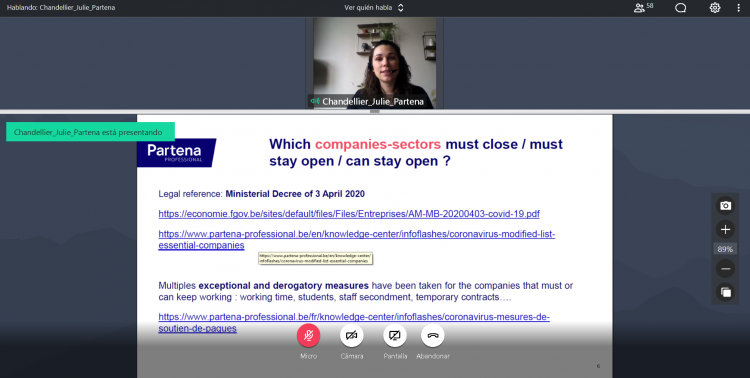 Likewise, they also mentioned the different procedures and temporary unemployment benefits for companies and their employees.
After it, the General Secretary of the Chamber, Marta González, introduced the representatives of the organizations of the different regions in Belgium. From the Brussels Region, Ariane Leonard, Economic and comercial Advisor, Representative of the Government of Brussels in Spain, and Aurore Boraczek, Inward Investment, hub.brussels, explained the measures taken in the Brussels Region such as the single bonus of € 4,000 for companies that have had to compulsorily close or the suspension of the so-called “city tax” for hotels. From Flanders Investment & Trade, Peter Verplancken, Deputy Director, Inward Investment & Aftercare, explained, among others, the financial incentives offered by the Flemish government or the postponement for the filing of taxes. Finally, Michel Winniczek, Project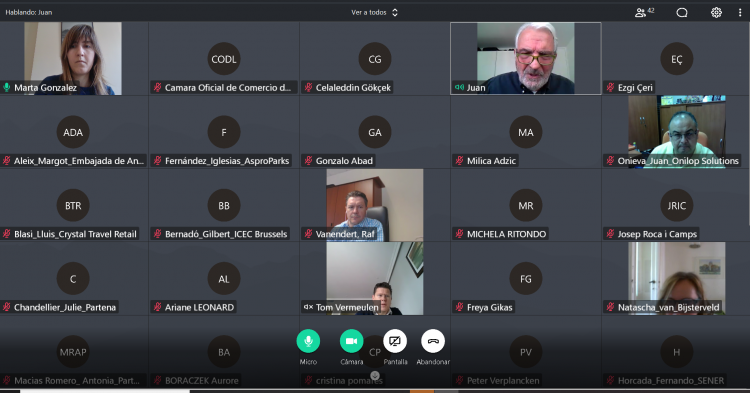 Manager from Invest in Wallonia (AWEX), informed about the different measures offered by the Walloon region to companies, the procedures for requesting these grants and the postponement of payment of fees.
After the presentation, a round of questions was featured where the participants could ask their doubts about the measures explained.
The Chamber wants to sincerely thank the SPF Finance, Flanders Investment & Trade, Brussels Invest & Export, Invest in Wallonia and Partena Professional for having participated in this initiative.
In collaboration with:
Breakfast-Conference: “Understand and promote the compliance”
Last 6th of February 2018, the Chamber organized a conference about the comprehension and the promotion of the compliance in collaboration with DS Avocats Law Firm. The event was attended by many representatives of Spanish and Belgian companies, as well as EU organization’s representatives, who were interested on the impact this topic could have on them, wanted to know which steps to follow in order to avoid the penalties their companies may suffer.
First, Jean-Marie Salva, partner of DS Avocats, started by pronouncing some welcome words and by thanking the attendees for their participation before presenting the law office’s work around the world. Then, he presented Ángela López de Molina, partner of the law firm, who will set a headquarters office in Madrid on March 1st.
During her presentation, López Molina spoke about the current legislation in Spain, which since the change of the Penal Code in 2015 which allows to impute criminal responsibility to the legal persons, requires the companies to design a crime prevention plan.
The compliance was created in 1970, in response to the corruption experienced by the United States through the legal persons.
The crime prevention plan is set as a series of measures of surveillance and control implemented to prevent the commission of crimes or, at least, to try to reduce significantly the possibility of being committed. To do this, it is necessary to count on the “Compliance Officer”, that is a person in charge of preventing all the possible crime situations and trying to solve them.
Furthermore, it is necessary for all the employees to have access to that plan and to expressly accept it. As a conclusion, Ángela mentioned the prevention, detection, answer and supervision activities necessary to credit that the company acts according to the law.
Later, Michel Debroux, partner of DS Avocats, exposed the evolution of the compliance through the years in Europe, which changed from something voluntary to something mandatory.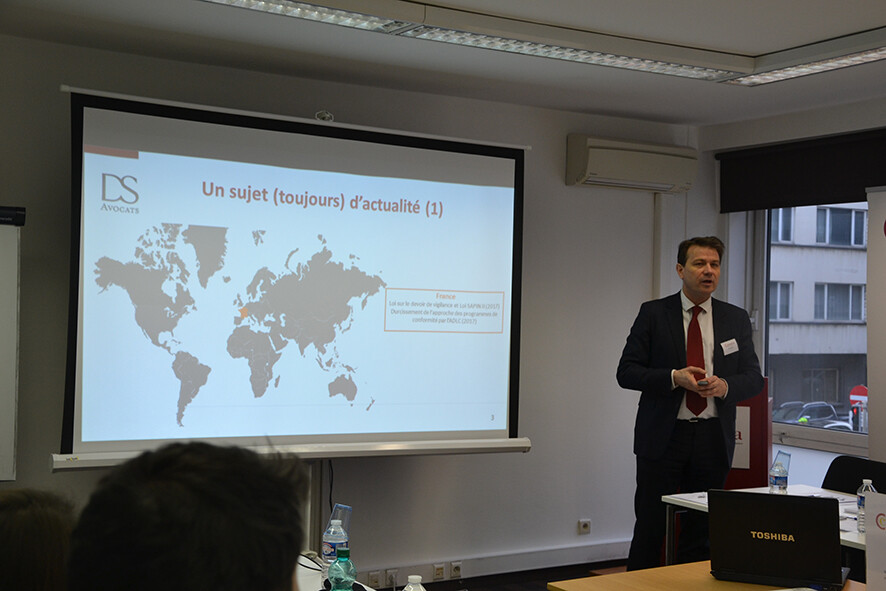
Debroux pointed out the existence of cultural differences to show the difficulty in unifying the action criteria, even inside a same company with offices established in different places of the world. Thus, he underlined the necessity of taking into account the local specificities to suit in law.
In the case of a company with offices in different places of the world, it is necessary for all of them to apply to the rules of the headquarter office and to its owns, as they have to fit in the local customs.
Thus, the compliance is a process which requires the organization, integration and verification of the regulatory compliance.
As López Molina explained, the speaker described the main tasks that the “Compliance Officer” needs to accomplish. He needs to establish a list with the potential risks. Therefore, he will need to be totally integrated in the company and has to be able to deal with crisis.
Finally, to conclude, the partner of DS Avocats presented what they call “the 10 rules of the perfect compliance project” in which the main characteristics to respect in order to manage perfectly this project are summarized.
The conference took part in a participatory environment during which every attendee had the opportunity to express their doubts and talk with the speakers.
In collaboration with: