
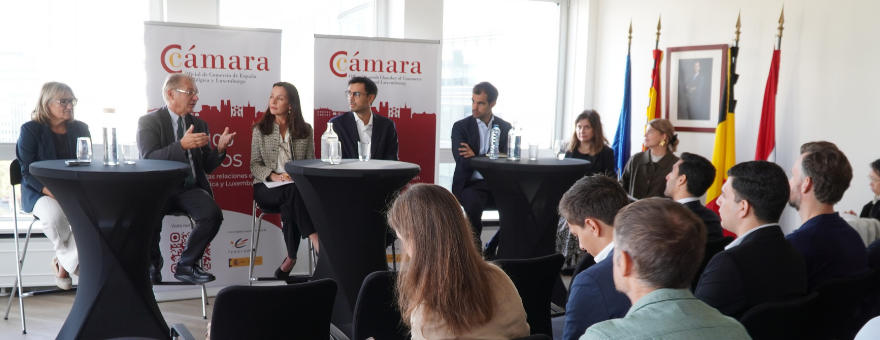
The Chamber and alinnea examine in Brussels the climate action of Spanish companies and its impact on competitiveness
The Official Spanish Chamber of Commerce in Belgium and Luxembourg and alinnea, the climate action think tank of IE University, held on Thursday 24 September, at the Chamber’s premises in Brussels, the event “Climate Transition and Competitiveness: Spanish Companies in the European Industrial Agenda”, which saw the presentation of the study “Climate Action in Spanish Companies”.
Following a welcome by the Secretary General of the Chamber, Marta González, Ana Belén Sánchez, Director of alinnea, presented the findings of the report, based on a survey of 800 companies of all sectors and sizes across the Spanish business landscape. The study looks at how widely climate action has been adopted by companies, what drives them to act, its relationship with innovation and competitiveness, the gap between large companies and SMEs, and the main barriers holding back the transition, including finance, demand and administrative complexity. One of the messages that resonated most in the room was that companies are not asking for lower ambition, but for clearer, simpler and more efficient regulation.
Financing, industrial policy and climate advantage
The panel discussion “Competitiveness and Leadership: Financing, Industrial Policy and Climate Advantage” then brought together Philippe Lamberts, Adviser to the President of the European Commission on Climate Transition and Green Deal Implementation; Mónica Peña Sastre, Senior Institutional Policy Adviser at the European Investment Bank; María Teresa Ruiz Costal, Head of Sustainability and European Funds at Ibercaja’s Corporate Banking Division; Carlos Sanz, Chief Operating Officer at Matteco; and Tullio Ambrosoni, Coordinator of the IE Brussels Competitiveness Hub.
The speakers agreed that climate action and competitiveness are two sides of the same coin and discussed the conditions needed for the transition to move forward: administrative simplification and faster permitting, regulatory predictability and stable market signals, mobilising private savings through the Savings and Investments Union, the role of public procurement in creating demand, and the financing and advisory instruments for SMEs already offered by public and private banks. The discussion also revisited the “think small first” principle, given the weight of SMEs in the Spanish economy.
The question and answer round addressed how to secure public support for the transition and how its costs and benefits are shared, and the event closed with a networking coffee. The Chamber thanks alinnea for its collaboration in organising this event.
In collaboration with: