
Tailored events
The Chamber of Commerce offers its members the opportunity to sponsor and co-organize events.
The goal is to provide member companies with the opportunity to use the Chamber—an independent platform—to promote their business, develop new clients, and increase their visibility.
What does the Chamber do?
Opportunity to share the event’s branding with the Chamber.
Inclusion of the sponsor’s logo on all event marketing materials distributed to attendees.
How to create your event?
Send an email to info@e-camara.com



New collaboration with the business association Agoria
The Official Spanish Chamber of Commerce in Belgium and Luxembourg is starting a new series of collaboration with Agoria, a Belgian association that brings together more than 1600 technology companies and whose main objective is to provide its member companies with personalized advice, access to market studies and a network of companies interested in collaborate in the field of technological innovation.
Last Th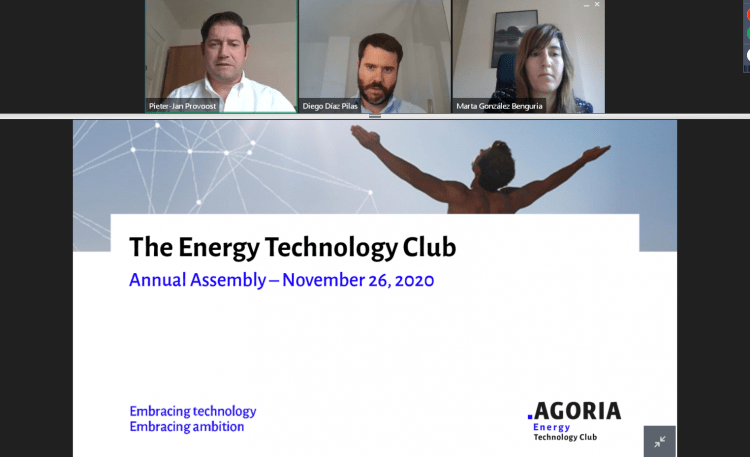 ursday, November 26th, the Chamber co-organized with Agoria’s Energy Technology Club a webinar focused on the opportunities to invest in Spain in the energy sector.
P.J. Provoost, Agoria’s Business Development Manager and Marta González, the Chamber’s Secretary General, welcomed all the member companies and expressed their satisfaction with this new collaboration. After them, María Palanca, Counsellor of the Economic and Commercial Office of the Spanish Embassy, explained the main energy policies in Spain and presented the areas in which investments are a priority as well as the relevant actors. For its part, the guest company, Iberdrola, described its main projects and explained the technologies in which they are interested in investing, through Diego Diaz Pilas, Head of New Ventures & Technology Prospects.
Webinar: Insurtech report: Discovering Future of Insurance
On November 26th, the Official Spanish Chamber of Commerce in Belgium and Luxembourg organized a webinar on ‘Insurtech report: discovering the future of insurance’ in collaboration with its member company everis. The event took place within the framework of the Spanish Financial Forum, a committee of the Chamber focused on the financial services industry.
Marta Gonzalez Benguria, Secretary General of the Chamber, introduced the webinar thanking the collaboration of everis and the participation of the panelists.
She then passed the floor to Richard Calvo, Insurtech Project Leader at everis, who began by presenting the fourth edition of the ‘InsurTech Outlook’ report, recently published by everis and NTT Data.
This report began to be prepared in 2016, when the investment in Insurtech produced the first impacts on the market. The growing trend of the sector has not stopped since then, reaching 6,300 million dollars in investments in 2019. Richard Calvo highlighted that among the different models of Insurtech, on-demand models and insurance for use, based on technologies such as IoT, Artificial Intelligence or Cloud&Mobile Applications, are those that have acquired the greatest importance, becoming the recipients of 90% of the investment. He also spoke of the main actors involved in the world of Insurtech, including investors, insurers and technological giants.
The report presented by Calvo also analyses the patterns that are repeated in successful startups, for which he uses the concept of ‘EXIT’, which refers to the purchase of a startup by another company and is an indicator of success.
Finally, the speaker indicated the main changes that have taken place in the Insurtechs sector as a result of the COVID19 crisis, among which he pointed out: the slowdown in investments, the variation in the Burn Rate KPI, and the creation of new investment opportunities such as in the Telemedicine and genome sector.
During the question time, attendees were able to present their doubts and comments on issues of interest, which were answered jointly by the everis experts: Dirk Croenen, Head of everis BeNeLux Insurance sector, Marc Durante, Director Insurance everis Luxembourg, Carlos Ordoñez Sanchez, Global Head of Digital Insurance and Richard Calvo. Thus, questions such as the possible change of paradigm in primary health care due to the combined effect of Covid-19 and digitalisation or where Europe is in the race to be at the head of the Insurtech sector with respect to the main players: China, the United States and India were dealt with.
The Chamber presents the EYE programme at KU Leuven University
On 16 November, the Chamber presented the Erasmus for Young Entrepreneurs (EYE) programme to 35 students of the Master’s in Business Economics in the specialisation of entrepreneurship and innovation at KU Leuven University.
During the class “Foundations of Entrepreneurship”, Paula Úbeda, Project Assistant of the Chamber, gave the students information about what the EYE programme is, who can participate, the registration process and the benefits of this programme. Furthermore, as an additional element, the Chamber presented the profile of a Dutch host entrepreneur interested in new entrepreneurs in the sustainable design sector in Belgium.
This presentatio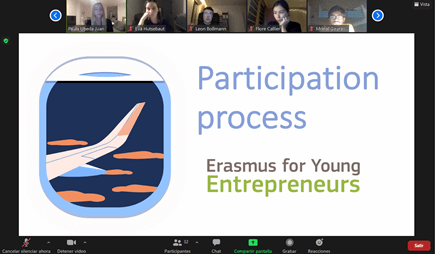 n and collaboration with the department of administration, strategy and innovation of the Katholieke Universiteit de Leuven demonstrates the importance of cooperation between universities and organisations to continue promoting and supporting future entrepreneurs in Europe.
The Chamber appreciates the invitation of KU Leuven University and Professors Michael Moedl and Pieter Vermeulen to present this international entrepreneurship opportunity to their students and looks forward to continuing collaboration with them to promote entrepreneurship and enterprise among university students.
If you would like to know more about the Erasmus for Young Entrepreneurs programme, please contact Soraya Bravo (project manager) sending an email to erasmus4youngentrepreneurs@e-camara.com.