
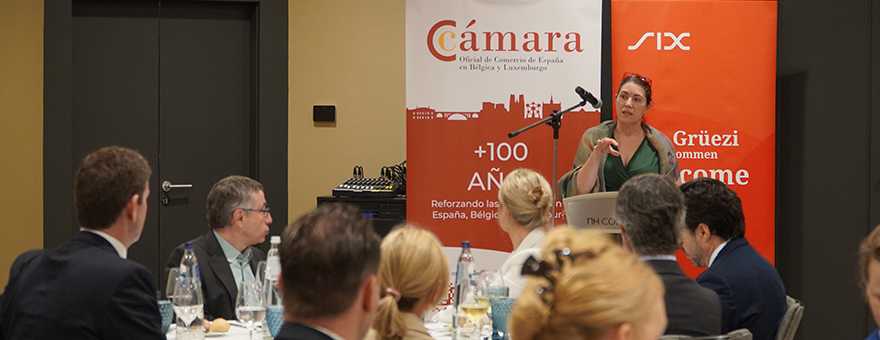
Cristina Dias discusses the EU’s efforts to channel savings into productive investment
On Thursday, 25 June, the Official Spanish Chamber of Commerce in Belgium and Luxembourg held a new business luncheon as part of its Business Circle, featuring Cristina Dias, Head of Cabinet of Maria Luís Albuquerque, European Commissioner for Financial Services and the Savings and Investments Union. During the event, the speaker outlined the European Commission’s priorities for advancing the integration of European financial markets and strengthening the Union’s competitiveness.
Following the welcome cocktail, the Chamber’s President, Pablo López Álvarez, welcomed the attendees and thanked the speaker for taking part in the event, highlighting her distinguished professional background.
The floor was then given to Juan Flames, CEO of SIX Group, the event’s sponsor, who stressed the need to develop mechanisms capable of channelling Europe’s substantial household savings into the productive economy. In this regard, he advocated the creation of a European Savings and Investment Account, inspired by successful models such as Sweden’s, to encourage citizens’ participation in capital markets through simple, transparent investment products supported by appropriate incentives.
The Savings and Investments Union: a new approach
During her keynote address, Cristina Dias explained that the new Savings and Investments Union (SIU) strategy represents an evolution of the previous Capital Markets Union initiative by bringing capital markets and the banking sector together under a single framework.
According to Dias, Europe possesses major strengths, including high levels of private savings, innovative companies and a highly skilled workforce. However, significant barriers still prevent this capital from effectively financing business growth and innovation. Among these obstacles, she highlighted regulatory fragmentation, differences between national insolvency and tax frameworks, and the remaining barriers to cross-border investment.
The Head of Cabinet underlined that the main innovation of the strategy lies not only in new legislative initiatives but also in a broader approach based on stronger coordination among Member States, improved implementation of existing rules and the gradual removal of the barriers that continue to fragment European financial markets.
She also emphasised that the success of the Savings and Investments Union should not be measured by the number of legislative acts adopted, but by its ability to create investment opportunities, foster economic growth and bring financial markets closer to both citizens and businesses.
The luncheon concluded with an engaging Q&A session, during which participants discussed the prospects for the new European strategy, the integration of payment systems and the reduction of regulatory barriers across the European Union.
Sponsored by:
