
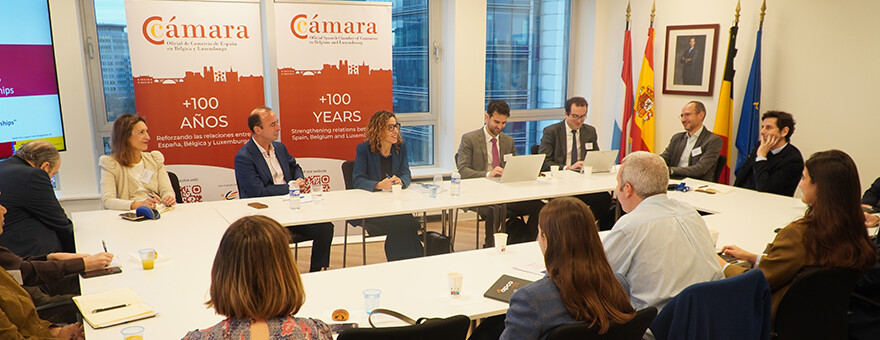
Nati Lorenzo analyzes the evolution of Global Gateway and its influence on international partnerships
On Tuesday, December 2, a breakfast debate took place at the Chamber in which Nati Lorenzo, member of the cabinet of Jozef Síkela, European Commissioner for International Cooperation, spoke on “Reframing Public-Private Collaboration: Global Gateway and the Future of International Partnerships”.
The session was inaugurated by Pablo López Álvarez, president of the Official Spanish Chamber of Commerce in Belgium and Luxembourg, who welcomed the participants and thanked the speaker for her presence.
Nati Lorenzo began with a brief explanation of the changes brought about by Global Gateway, created in 2021, which marked the transition from a fragmented model of external cooperation to a more unified and consolidated framework. As a result, the numerous external instruments covering the various lines of cooperation and development are now integrated under a single main financial instrument, the NDICI-Global Europe. It has five priority areas of investment: transport, energy, digitalization, health, and education and research. This change also redefined the role of Member States, which are now fully integrated into the decision-making process.
With the arrival of the COVID-19 pandemic, the Global Gateway strategy demonstrated its ability to effectively bring together the private sector and public institutions in response to a global health crisis, facilitating the coordination and financing of projects related to the creation and distribution of vaccines.
The initial goal was to mobilize up to €300 billion in global investments; however, this number has already been reached, with more than €306 billion to date. Nevertheless, there are also challenges to be faced. Lorenzo points out that the biggest challenge is to “get better faster”: Global Gateway has built global trust, but not fast enough. In the current sensitive geopolitical landscape, it is crucial to promote mutual benefits with partners that contribute to strengthening resilience against rivals, which requires further improving and adapting existing tools.
Following the speaker’s presentation, a question-and-answer session was held, in which professionals from different sectors and with different interests participated, giving rise to an enriching debate. Topics discussed included the financial support intended for Latin America, the role of NGOs as key players in the implementation of projects, and the role of SMEs and what they can contribute within this collaborative framework.
