
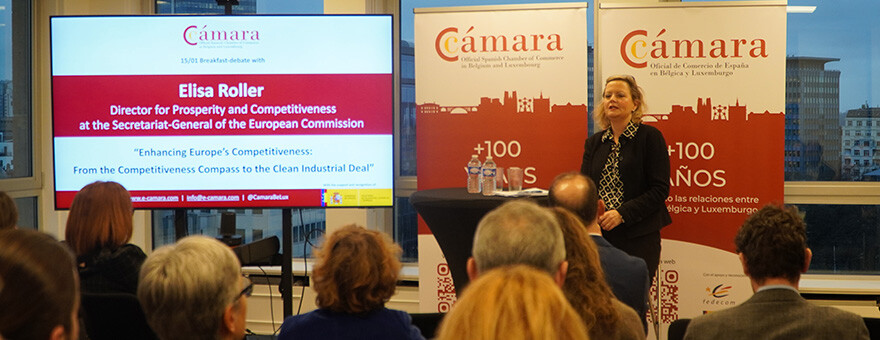
Elisa Roller analyses European competitiveness and strategic autonomy within the framework of the Clean Industrial Deal
On Thursday, 15 January 2026, the Official Spanish Chamber of Commerce in Belgium and Luxembourg organised a breakfast debate with Elisa Roller, Director for Prosperity and Competitiveness at the European Commission’s Secretariat-General. During the meeting, entitled “Enhancing Europe’s competitiveness: from the Competitiveness Compass to the Clean Industrial Deal”, Roller addressed the main challenges of the European competitiveness agenda in a rapidly changing global context marked by industrial transition and geopolitical changes.
The talk began with a few words from the President of the Chamber, Pablo López-Álvarez, who thanked the speaker for her presence and highlighted the relevance and topicality of the subject. Elisa Roller then introduced the concept of strategic autonomy, emphasising the need for the European Union to strengthen and modernise its trade tools to adapt to a rapidly changing global environment and preserve the competitiveness of its industrial base.
In her speech, Roller pointed out that, despite the significant challenges facing the European Union, there are also reasons for optimism, such as the growing international importance of the euro and efforts to move towards a more integrated European labour market in line with the targets set for 2030. In this context, he reflected on how Europe can remain competitive in a scenario of increasing international competition.
Reconciling decarbonisation and competitiveness
The speaker also referred to the importance of reconciling decarbonisation objectives with maintaining competitiveness, addressing issues such as taxation, regulation and investment support. She also pointed to current challenges in the field of energy, highlighting energy prices as one of the major challenges for European competitiveness and the need for an affordable action plan.
Looking ahead, Elisa Roller pointed to some lines of reflection on the evolution of the European strategic agenda, highlighting the importance of having clear indicators that reflect the priorities of European leaders, as well as strengthening Member States’ commitment to investment and the single market, advancing harmonisation within Europe.
In conclusion, Roller recalled that, once the framework for action at European level had been defined, the current phase focused on implementation, which largely fell to the Member States and co-legislators. In this regard, he stressed the need for clear political will to move forward, define the scope of European action and ensure effective commitments. Following the presentation, a Q&A session was held in which attendees discussed the challenges of coordination between Member States and the impact of the changes already underway in various economic sectors.
