
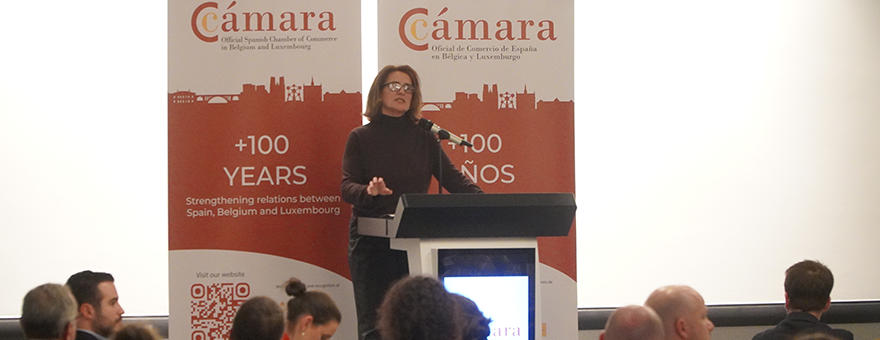
Teresa Ribera examines the key factors for boosting competitiveness and sustainability in Europe
On Wednesday 17 March, the Official Spanish Chamber of Commerce in Belgium and Luxembourg held a luncheon-debate as part of its “Business Circle”, at which Teresa Ribera, Executive Vice-President of the European Commission for a Clean, Fair and Competitive Transition, gave a presentation outlining the EU’s roadmap to boost the competitiveness of its business and industrial sectors whilst strengthening the sustainability of its consumption model.
After the welcome cocktail, the president of the Chamber, Pablo López Álvarez, opened the lunch by thanking the speaker for her participation in the debate and overviewing her career.
Ignacio García Magarzo, Director General of ASEDAS (the Spanish Association of Distributors, Convenience Stores and Supermarkets) – the event’s sponsor – then took the floor, highlighting the responsibility of the distribution sector and the importance of maintaining its competitiveness as a driving force for social welfare.
An agenda with a dual purpose
During her speech, Ribera emphasised that competitiveness and sustainability now form part of the same strategic agenda. In this context, she highlighted the role of electrification, the strengthening of networks and the integration of the European energy market as key elements in ensuring security of supply, resilience and industrial development. These objectives aim to advance the EU’s energy independence.
She also argued for the need to maintain an open economy, but one based on a level playing field, with greater transparency and high standards that promote quality and innovation. She also stressed the importance of providing clear and stable long-term signals to encourage investment, whilst avoiding the fragmentation of the single market.
The speaker also addressed issues such as security of access to raw materials, the role of the digital economy and the importance of coherent regulatory frameworks to support Europe’s industrial transformation, thereby fostering a high level of reliability in the institutions.
At a time when “the mere idea of cooperation has become a value”, Ribera highlighted the “huge potential” that European integration can offer in terms of boosting productivity and competitiveness.
Following the presentation, there was an extensive question and answer session in which topics such as the challenges facing the energy sector in the current climate were raised.
The event was sponsored by ASEDAS and organised in collaboration with the Spanish Chamber of Commerce’s Delegation to the European Union.
Sponsored by:

In collaboration with: