
Breakfast-debate with José Blanco and Alejandro Ulzurrun: Renewable Energy and Electric Market

The past April 25th, the Official Spanish Chamber of Commerce in Belgium and Luxembourg hosted in its Brussels’ headquarters a breakfast-debate with  José Blanco López, MEP and member of the Committee on Industry, Research and Energy and Alejandro Ulzurrun de Asanza y Muñoz, Head of Unit at DG Energy, about the “New legislative package of the European Commission on Renewable Energy and the design of Electric Market”. Between the participants, there were members of the Chamber, business executives and representatives of European institutions.

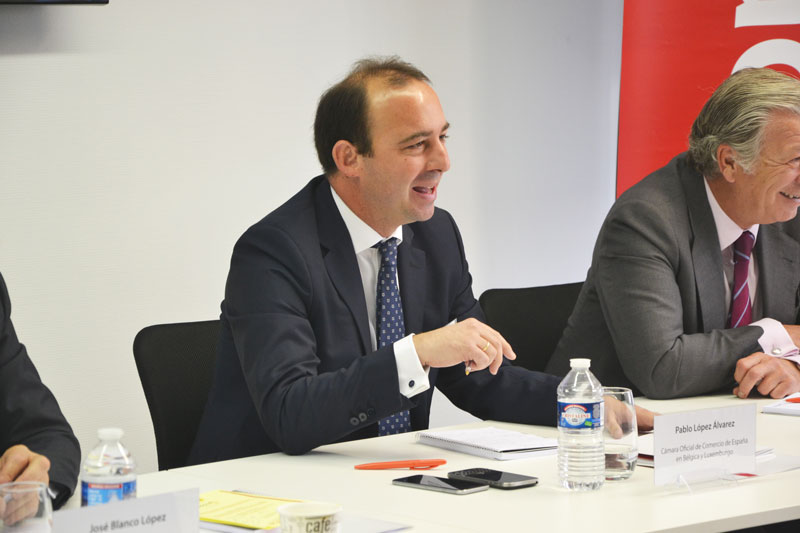
Pablo López Álvarez, Vice President of the Chamber, started by introducing the speakers and thanking their participation and all the attendees’. Before starting with the speeches, he made a brief introduction about the relevance of the current energy sector and its regulation in the European Union agenda.
   blank

Afterwards, Joaquín Mollinedo, Chief Institutional Relations, Sustainability and Brand Officer of Acciona, took part and pointed out Spain as a reference in the renewable sector, as well as the interest of Acciona in taking part on this sector from an industrial perspective and along with the EU commitment. Therefore, he wanted to underline his conviction on the new legislative package to promote a cleaner Europe, the energy sector and innovation.

Furthermore, Alejandro Ulzurrun, Head of Unit at DG Energy, made a summary of the Commission’s proposal, which he defined as “the chance to upgrade the European economy”. In his speech, he underlined the year 2015 for the energy sector, in which there was a record on global investments and around 8 million jobs were created.

Between the main elements of the project, Ulzurrun established four priorities: renewable energy, energy efficiency, electric market and governance. This project, defined by Ulzurrun as balanced and ambitious, covers almost all legislation they want to approve in order to achieve the EU goals.

Finally, Ulzurrun reminded the common interest between the Commission and the Parliament, giving as example their joint declaration of legislative priorities they agreed to pursue a significant progress through the year 2017, in which the new energy legislative package is included”.

José Blanco, MEP and member of the Committee on Industry, Research and Energy, started his speech thanking the the European Commission’s cooperation in the energy sector and explaining the two main goals of the Parliament in this field: recovering the leadership of the EU in clean energy and pursuing the goals set in the Paris Summit for 2020, like decarbonisation.

blank blank

On the other side, Blanco highlighted the importance of legal safety in the EU, which he considers “essential to assure investements, which are so necessary”. In addition, he pointed out that, from the Parliament, they have the responsibility to learn from their own experience and to look for a regulation framework in the energy field that allows the economic modernisation and to build qualified jobs.

Finally, he insisted in the will of the Parliament to listen to different proposals in order to find a balance that enables the approval of the new package draft, in order to be able to present it to the plenary by the end of the year.

Once the speeches were given, our Vice President Pablo López began the debate, which had a high level of participation with different points of view from representatives of the main companies of the energy sector, consultants and members of the European institutions.

The main topics of the debate were about legal safety, the efectiveness of the legislative proposals in the energy field, the sources of financing for renewable energy and the different positions about the binding nature of the proposals and their legal framework.


Event sponsored by:

blank

[AFG_gallery id=’50’]

Breakfast-debate with Miguel Ceballos Barón, Deputy Head of Cabinet of the commissioner Cecilia Malmström

Last April 20th the Official Spanish Chamber of Commerce in Belgium and Luxembourg organized a breakfast-debate about “the commercial agenda of the European Union in 2017”. The event took place at the Chamber’s headquarters in Brussels, with Miguel Ceballos Barón, Deputy Head of Cabinet of the commissioner Cecilia Malmström as the main speaker. At the event, there were members of the Chamber, business executives and representatives of European institutions and delegations.

blankPablo López Álvarez, Vice President of the Chamber, made a brief introduction of the speaker, thanking him and all the attendees for his presence, as well as the importance of the commercial agenda in the current difficult international context.

Then, Miguel Ceballos began his intervention making a synthesis about the current context and the determining issues in the commercial field, like the beginning of Donald Trump’s legislature and the recent signing of an executive order to review a temporary visa programme used to place foreign workers in high-skilled US jobs. Between others, he underlined the Turkish referendum, the upcoming elections in France and the UK and the Brexit.

Furthermore, Ceballos explained the main commercial challenges at a European level, going through the different continents and the evolution on free trade agreements. He remarked, in first place, the Comprehensive Economic and Trade Agreement (CETA) which, after the stoppage of the Transatlantic Trade and Investment Partnership (TTIP) with the United States, stands up as one of the most important agreements for our exportations and companies, mostly in the public services sector, such as water or energy. Plus, the CETA assures an access to Canadian tenders avoiding big competitors such as China and Mexico.

On the other hand, the speaker explained the recent developments in different agreements such as in Mexico, in which they pretend to remove sanitary barriers for farming products, as well as improving the investment agreement, underlining the sectors of energy, telecommunications, financial and oil. Regarding Chile, Ceballos highlighted the modernization phase of the current agreement and their will to increase the services,

Regarding the Asian continent, Ceballos underlined the already stablished agreement with Japan, hightlighting the competitive advantage the UE has in this market as a consequence of the TTIP stoppage, avoinding the competence of USA, Australia or New Zealand. Moreover, he wanted to mention Singapur, which he defined as a small economy with a lot of potential for commercial relations in the future. On the other hand, he informed about the agreement with Vietnam, which is currently being translated and will be presented to the Parliament soon.

At last, Miguel Ceballos assured the importance of the agreement with the Mercosur countries (Brazil, Argentina, Uruguay and Paraguay) which gather more than 250 millions of consumers similar to Spanish consumers, which turns out to be specially interesting for commecialization in all sectors.

The launching of this agreement, expected by the end of 2017, would imply a 400 millions of euros savings for Spain, which they are currently investing in custom fees. The new agreement pretends to increase transparency and objectivity of commercial relations.

Miguel Ceballos  finished his intervention blankunderlining the importance of the current political and social background, and the evolution of  commercial agreements through the years, which include more regulations every day, like social and environmental dumping. As examples, he mentioned anti-corruption in the Mexico agreement and the gender issue with Chile. Finally, he thanked everyone for their presence and the contribution of the Chamber and the Spanish companies in the commercial field.

After the speaker’s interventions, our Vice President Pablo López opened the debate, which was marked by a high participation of the attendees. Between the main issues, the topics were the resistance to the inclusion of financial services in trade agreements, the recently presented White Paper of the European Union and, most importantly, the future of the United Kingdom after Brexit.

Moreover, there was a discussion on the issue of the agreements of the African continent, in which Ceballos highlighted the agreement with South Africa, and the progress on the ones with Namibia, Botswana, Mozambique and Ghana. At last, they referred to the commercial agenda of growing countries, mentioning the asymmetric agreement with the Caribbean area.