
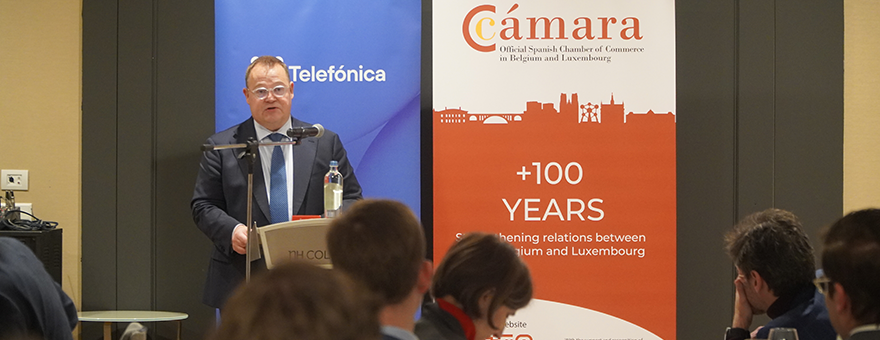
Antti Timonen outlines the Commission’s work to move towards a sovereign digital Europe
On Thursday, 29 January, the Official Spanish Chamber of Commerce in Belgium and Luxembourg held a new lunch-debate as part of its ‘Business Circle’ tribune, at which Antti Timonen, Head of Cabinet of Henna Virkkunen, Executive Vice-President for Technological Sovereignty, Security and Democracy at the European Commission, gave a presentation entitled “Towards a sovereign digital Europe”.
After the welcome cocktail, the president of the Chamber, Pablo López Álvarez, opened the lunch by thanking the speaker for his participation in the debate and overviewing his career.
Juan Montero Rodil, Director of Public Policy, Competition and Regulation at Telefónica, the event’s sponsor, then took the floor, opening the conference by focusing on the crucial moment the telecommunications sector in Europe is currently facing. ‘The level of external overdependence on digital services is much higher than in other sectors,’ said Montero, adding that, in the current context, this poses an ‘existential challenge’ for companies in the sector.
Digital independence
For his part, Timonen began his presentation by confirming the need to increase the security of European telecommunications systems, which are ‘consistently vulnerable’ to external threats. In this regard, he said that the Commission is working closely with Member States to create the necessary conditions to encourage investment in cybersecurity.
Among the specific initiatives being worked on by Commissioner Virkkunen’s office, the speaker highlighted the European Digital Identity Wallet, which will allow citizens to verify their identity online in a simple, fast and secure way.
The basis for strengthening the telecommunications sector will be ‘digital infrastructure and artificial intelligence’. According to Timonen, the EU’s current position on digital issues is to try to transform Europe into the leading AI continent through an action plan that includes, among other projects, the creation of modern, sustainable and innovative data centres and the acceleration of the implementation of AI in Europe.
Following the presentation, there was an extensive question and answer session in which topics such as the EU Quantum Act and the promotion of open-source software were discussed.
Sponsored by:
