
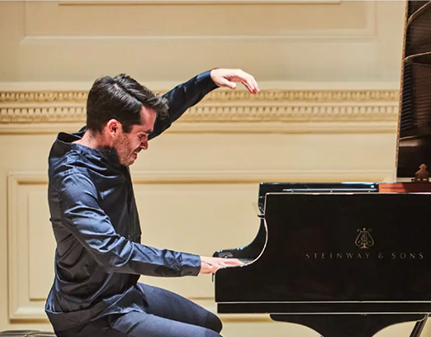
“It is essential that institutions such as the Spanish Embassy, the Official Spanish Chamber of Commerce in Belgium and Luxembourg, in this case, and indeed Spanish representative bodies around the world, support these initiatives”
Where does your passion for music come from? And for the piano?
My passion for music comes from the environment in which I grew up, because my parents are musicians: my mother is a pianist, my father an orchestra conductor, and both are teachers as well. So that’s also the answer to my love of the piano. It began when I was a child. At home, ever since I was born, there were sheet music, vinyl records, CDs… And, most importantly, a piano and two parents who knew how to encourage and nurture that love of music.
Do you remember the first song you ever played in full on the piano? And your first concert?
The first pieces I ever played in full on the piano were really just little songs or carols that you learnt when you couldn’t even read sheet music or musical notation properly yet. You learnt everything by touch and by ear. I do remember that, at one of my first, if not my very first conservatoire recital, I played one of Beethoven’s Scottish Dances, which is a tiny, easy and very charming piece.
Even so, it’s true that one of my earliest musical memories is perhaps El amor brujo by Manuel de Falla. Not because I played that piece when I was very young, but because my mother played it. I remember taking the score from her and sitting down at the piano to try to make sense of it, to see how it worked and, with my limited abilities, to try to play something.
You’ve performed on major international stages and played with orchestras from all over the world. Is there a particular venue or city that has left a lasting impression on you?
One of the venues that has left the deepest impression on me is actually one of the most recent ones I’ve performed in. I recently made my debut in Japan, in Tokyo, and the country has had a profound impact on me both personally and artistically – as one would expect from a country as special as Japan. Apart from that, I’d have to say London, home to two of the world’s finest concert halls: Wigmore Hall and the Royal Albert Hall. I’d say those are the places that have left the deepest impression on me.
Even so, I’d add two venues: the Teatro de la Maestranza, as it’s in my hometown, Seville, and it’s a fantastic venue; and the Auditorio Nacional in Madrid, where every time I’ve played there it’s been a very special moment in my career, and very intense on an emotional level.
Why is it important for institutions such as the Spanish Embassy and the Official Spanish Chamber of Commerce in Belgium and Luxembourg to promote Spanish cultural talent on the international stage?
This is of paramount importance. It is essential that institutions such as the Spanish Embassy, the Official Spanish Chamber of Commerce in Belgium and Luxembourg—in this case—and indeed Spanish representative bodies around the world support these initiatives. I would say that in the current climate there is an emphasis on localism, regionalism and ‘local identity’, which also has its positive side, but the aspect of ‘identity solidarity’ that interests me most is precisely this: helping one another, especially in places that are unfamiliar to us.I have had many professional opportunities abroad when I have been invited by a musician, a promoter or a Spanish institution. For my debut with an orchestra in the United States, for example, I was invited by the conductor Max Bragado-Darman, from Madrid, who was there as principal conductor of an orchestra in the United States and invited me. I recently played in Naples with the orchestra of the Teatro San Carlo, because I was invited by Pablo Mielgo, also a Spanish conductor.
I am even going to play in Santo Domingo with my VibrArt trio – comprising violin, cello and piano – at a concert organised jointly by the European Union Embassy in the Dominican Republic, thereby extending the sense of identity to the European context.
It is essential, and it is what all countries do: they take it upon themselves to promote home-grown talent, and that is how it should be.
The event will take place on Thursday 25 June at 7.00 pm at the Philharmonie (1 Pl. de l’Europe, 1499). This is a unique concert by one of the most acclaimed musicians of his generation, the pianist Juan Pérez Floristán. Winner of the Paloma O’Shea International Piano Competition (2015) and the Arthur Rubinstein Competition in Tel Aviv (2021), Floristán combines a refined technique with great artistic sensitivity. This will be followed by a networking cocktail reception at the Hotel Meliá Luxembourg (1 Park Drai Eechelen, 1499), where Spanish cuisine will be showcased.
