
European Tender Week

On April 27th, 28th and 29th, the Official Spanish Chamber of Commerce in Belgium and Luxembourg, organized a webinar on “European Tender Week”, in collaboration with Karine Brück.

This webinar aimed to provide participants with information on European tenders, with two levels both for beginners and experienced users. Karine Brück, who conducted the webinar, has over 15 years of experience in European tenders and is the founding partner of Karine Bruck International (Ecosolve SL).

This webinar was aimed at European companies interested in learning how to prepare and manage European tenders which offer a great opportunity in the midst of this global crisis. Thus, thanks to the webinar the participants received all the necessary information so that their companies, from very different sectors, can take advantage of these new opportunities offered by European tenders.
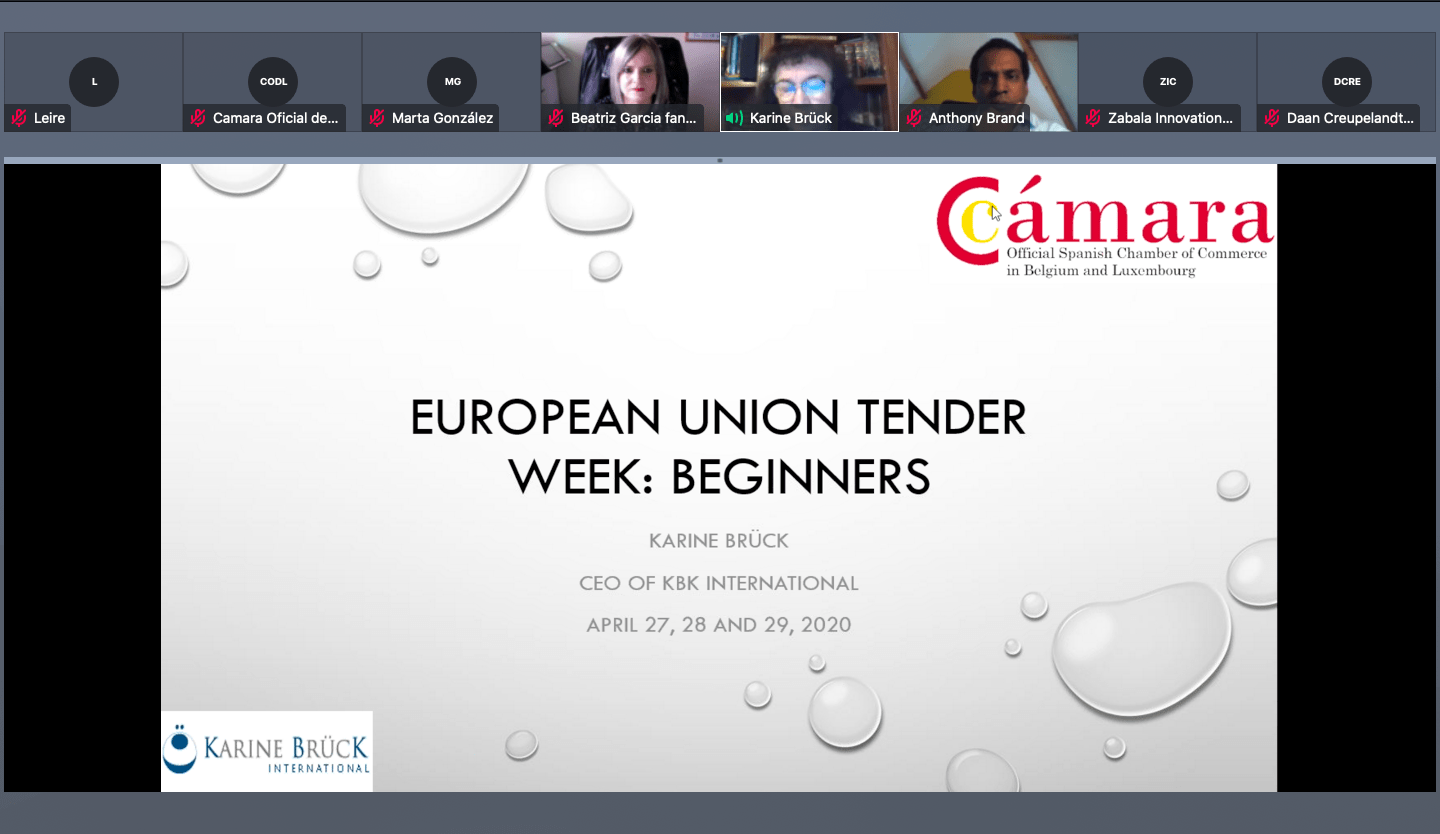
In the first session, the concept of European tenders was introduced and its core functioning was explained. At the beginners’ level, participants were explained the types of tenders, market opportunities, basic requirements for participation, and the main advantages and difficulties often encountered in the process. At the advanced level, a practical analysis of the procedure and the administrative terms and legal documents required was made.

In the next session, the beginners’ group worked on a preparation strategy and the speaker made basic recommendations to avoid the most common mistakes of companies that are applying to this type of European procedure for the first time. Moreover, the main sources of information and how to find the most interesting opportunities for each company were analysed. At the advanced level, the key elements for a winning technical proposal and the best practices on its elaboration process were worked on.

In the third and last webinar, both groups worked on a practical example of a bidding process. The speaker explained in detail, from the identification of the opportunities of the tenders to recommendations and practical advice, also including a methodological proposal of preparation and key elements to be taken into account. In addition, after each session question rounds were conducted, in which participants could raise doubts about the information presented and about their company’s specific sector.

The Chamber wants to sincerely thank Karine Brück once again for her enriching presentation and her enormous dedication, as well as to the participants for their attendance.

The Spanish government implements four phases for de-escalating the confinement measures until June

The President of the GovernmentPedro Sánchez, presented last Tuesday the de-escalation plan after the approval by the Council of Ministers. The Spanish population has been waiting for this plan after more than six weeks of confinement due to the coronavirus pandemic. The plan will consist in four phases, with a period of 15 days between each phase, as long as “the evolution of the pandemic continues to be favorable and under constant evaluation by the corresponding institutions“.

The president stated that “the phases will last a minimum of two weeks because this is the average incubation time of Covid-19. In this way, we can make decisions based on the effects that each phase has had on each territory”. President Sánchez also confirmed that mobility between provinces and islands will continue to be restricted to the ones contemplated in the state of alarm decree.

The progress between phases will be determined by objective criteria based on parameters that will show the disposition of each province: healthcare capacity, both in primary care and hospital care, and in the number of ICU beds in each of the territories. It will also be taken into account the epidemiological situation in each area, with diagnoses and identification of the pandemic; implementation of joint protection measures in public spaces, and mobility and socioeconomic data.


Phase 0:

The phase zero, which is the first phase, has already begun.  It is about preparing the transition to deconfinement and the start of “relief” measures such as the one allowing minors to go out last Sunday or the possibility of outdoor sports and small walks from  May 2nd onwards.

In addition, “small activities” of economic nature will be allowed by appointment. For example, restaurants with home delivery service can open but there will be no consumption possible inside. The preparation of all public spaces will also be intensified, with appropriate signalization of protective and hygienic measures, and the training of professional athletes will be allowed.

Even though “the back-to-normal measures are gradual and coordinated”, they will also be asymmetrical according to the particular situation of each province. Therefore, all the territories are expected to be in phase zero on May 4th. However, FormenteraLa GomeraEl Hierro and La Graciosa islands “due to their favorable evolution”, will start phase one on the same day.


Phase 1:

President Sanchez points out that from May 11th onward all provinces will start phase one and, from then on, the evaluation will be individual and every two weeks. “We will implement the phases at different speeds, and we will not go to the next phase until we have consolidated the previous one”, explained president Sánchez as he remarked that each territory will have its own rhythm.

This period will be characterized by the fact that in each  province, some small commercial activities will begin. This will not be the case for large shopping centers or commercial parks. In the tourism sector, for example, the opening of terraces will only be at 30% of its capacity. Additionally, hotels will return to operate excluding common areas.

This phase will also include preferential hours for the elderly (over-65) in some premises, as well as a one-third occupancy rate regulations in places of worship for religious events. The use of masks will be highly recommended in the public transport.


Phase 2:

If phase one is properly conducted and no further outbreaks occur, phase two will begin with the opening of premises to one-third of its total capacity. Schools will also open to all those families with children under six years of age so that they can attend to their educational centers while their parents are working. Hunting and sport fishing will be once again allowed and cinemas and theaters will open with one-third of their capacity operational and assigned seats.

Exhibitions and monuments may be visited again, and cultural shows with less than 50 people will be allowed as limited capacity. In the case of events in public spaces, the total number of attendees may be 400, provided that they are seated.


Phase 3:

Phase three, which will be the most advanced and the last before resuming normal life, will only come if all the required parameters are met. During this period, mobility will be more flexible but with the recommendation of the use of masks in public spaces and transportation. Furthermore, in touristic sector, the measures will be softened, but it will be necessary to continue taking into consideration the measures of social-distancing and hygiene.

The social restrictions will end, but the hygiene measures will have to be maintained. It must be this way until a vaccine to cure the coronavirus is found“, said president Sánchez. He also pointed out that mobility between provinces can only be resumed when the ‘new normal’ has been reached, not before, especially if we consider that there may be territories in different phases.

If everything happens as the Government expects, the last phase could be finished in a six-week time. In that case, June 22nd could be the date of the total ‘new normality’ in Spain. In the worst-case scenario, if the evolution does not go as expected in some territories, the de-escalation will last up to eight weeks and the final date of de-escalation could be June 29th.


Source: Elconfidencial.com

Measures taken by the National Security Council of April 24th, 2020

On the basis of recommendations from the Group of Experts in charge of the Exit Strategy (GEES), the National Security Council met today, Friday April 24th, to determine the exit strategy from the corona crisis. Hopeful indicators, such as the reduction in the number of daily hospital admissions or the flattening of the mortality curve now make it possible to start phasing out very gradually. But the government stresses that the virus is still present on our territory and remains dangerous.

It is important to emphasize that certain rules remain in force, even as were scaling down the measures. Rules such as:

– Limiting contact with people

– Respecting safe distances

– good hygienic reflexes, also called “barrier gestures

– Use of masks in public areas and public transport for users aged 12 years and over.

– Travel by your own means instead of public transportation and avoid rush hours.

Phasing out strategy

The strict containment measures will certainly remain in place until 3 May. Belgium could then start phasing out the measures, if circumstances permit. All of the following dates are subject to change depending on the health situation and the evolution of the virus.

  • Phase 1-A (4 May)

Working from home is still the standard.  For example, if companies cannot meet the physical distancing requirements, they will be able to compensate by following a series of health recommendations, such as wearing a mask.

The rules do not change for shops and the hospitality industry, except for the fabric shops, which – given their important role in the production of mouth masks – are allowed to open their doors.

Working groups are already studying how to respond to the need to continue to provide the best care to people infected with covid-19 while gradually and safely expanding access to general and specialised health care. The aim is to ensure that everyone regains ‘normal’ access to healthcare as soon as possible and that the medical infrastructure needed to care for people suffering from the virus is not overburdened.

Physical activity in the open air is allowed with a maximum of two people in addition to those living under the same roof, provided that physical distance is always respected.

It will also be allowed to practice other non-contact sports in the open air. But access to changing rooms, communal showers and cafeterias is still forbidden.

  • Phase 1-B (11 May)

This phase allows all shops to reopen at the same time – without discrimination on the basis of size or industry – in order to give everyone the same chance of success. This will of course be subject to conditions. These will be determined in consultation with the industries and the social partners.

There are three types of conditions, relating to: work organization, welcoming in clients and restricting access to shops to avoid hustle and bustle.

Carrying out so-called contact professions (such as hairdressing, for example) is not permitted at this stage.

Future of sports competitions will be also clarified in the short term.

  • Phase 2 (18 May)

The government  look at whether and under what conditions so-called contact professions can be resumed, again under certain conditions.

The opening of the museums can also be considered during phase two, also under certain conditions, for example through a ticketing system.

Team sports will be possible in the open air, but only in a club setting and subject to certain conditions.

Lessons will very gradually resume from the 18th of May. Not all pupils/students will be able to go back to school immediately. Each Community will be responsible for implementing this decision on its own territory, in consultation with the education sector.

Also, certain possibilities will be examined, such as:

– the ability to hold private meetings at home

– the ability to permit more people at weddings and funerals.

– allowing more than two people to be active outdoors together

– the possibility to organize day trips to certain regions of the country.

  • Phase 3 (8 June at the earliest)

Multiple points will be examined:

– How to organize the possible and gradual reopening of restaurants and, at a later stage, cafes, bars and the like. This will in any case have to be done under strict conditions.

– Various summer activities such as trips abroad, youth movement camps (to be decided at the end of May), internships, tourist attractions but also smaller open-air events. The only certainty is that mass events such as festivals are not allowed before 31 August.


Source: Belgian.be

Financial support measures for small businesses in Luxembourg

Micro and small commercial and artisanal companies will be able to benefit from additional financial support measures after the adoption last Wednesday of the regulation of the Governing Council of the Grand Duchy.

Companies with between 10 and 20 workers may benefit from a compensation that amounts to a lump sum of 12,500 euros.

In addition, companies with fewer than 10 workers will also benefit from new measures. An additional compensation of 5,000 euros will be awarded to those who, forced to close or stop their activities, suffered a loss of at least 50% of their turnover during the period between April 15th and May 15th.

“We are strengthening immediate financial support for micro and small businesses because they are generally the most vulnerable to unpredictable events like Covid-19. Effective and prompt support is essential in times of crisis,” said the Minister for the Middle Classes, Lex Delles.

Detailed information is available since April 24th on the Guichet.lu website. The form to send applications, which will be processed by the General Directorate of the Middle Classes, is also available on that same website.


Source: Paperjam.lu

Extension of the measures taken by the Walloon Government against Covid-19

On 22 April, the Walloon Government presented additional measures to address the consequences of the health crisis in the region. Main measures taken:


Economy / Employment

285 million in addition to the 233 million euros already allocated in March to support the economy, businesses and the self-employed workers:

Extension of the categories for the fixed allowance of Sectors concerned: mechanics, artistic and entertainment businesses, gyms, horse-riding centres, cinemas, real estate agencies.

Introduction of a second fixed allowance of 2,500 euros for self-employed workers/businesses that have only been able to operate partially during the containment period and have benefited from the right of transition.

Creation of the transitional loan for self-employed workers who need cash to get through the transition. Loans of a maximum amount of 45,000 euros at a favourable interest rate and for a maximum period of 5 years. This loan will be financed in two thirds by the banks and in one third by the public entity SOWALFIN. This last one will guarantee 75% of the reimbursement. Attention! The repayment loan cannot be cumulated with the overall compensation.

In total, the Government estimates that between 110 and 115,000 self-employed persons/enterprises will benefit from this aid.


Health/social measures

1 million for the purchase of food for entities active in food aid.

Increased support for housing infrastructure (in addition to that already granted in March) to help them cope with the additional costs related to the crisis: an additional 250 euros for residents in mental health centres and housing infrastructures for people with disabilities and an additional 400 euros for each bed authorised in the MR-MRS.

Hiring of 140 psychologists who will provide support and accompaniment to the residents and care staff of these reception centres.

Assistance for the accompaniment of disabled people confined in their homes

5 million euros reinforcement for the financing of the Walloon CPAS to enable them to meet new needs and new target groups.

Financial support for the 88 family and elderly care facilities and the 6,500 workers in this sector: 80% compensation for the loss of co-payments (for the covid lost hours) provided that the workers for whom the hours are declared are not unemployed.

Overall compensatory aid of 5,000 euros to the 124 companies approved as Social Economy Initiatives, to the Structures for Supporting Self-Creation of Employment (SAACE), to the Advisory Agencies on the Social Economy (ACES).


Housing

Loans at 0% interest granted by the Société Wallonne de Crédit Social for tenants who have difficulties paying their rent. Maximum term of 6 months, repayable in 36 months.

Kot: possibility for students to terminate the student rental contract early.

Authorisation to extend the current lease for those who cannot move.


Energy

Gas/electricity: aid of 100 euros (electricity) and 75 euros (gas) for people who have a budgeted counter (aid in the form of a deduction on the regularisation bill). This measure affects some 100,000 Walloon households.


Water

For citizens with payment difficulties:

Prohibition of any suspension of water supply and limitation of water flow for a period of 60 days from 1st April 2020.

Reinforcement of the aid granted by the Public Social Assistance Centres (CPAS) to people in a precarious situation with an exceptional additional allocation of 500,000 euros to the Water Social Fund.


For the self-employed, SMEs and companies:

With a simple request, a deferral of payment of invoices or a deferral of payment will be granted.

Revision of the quarterly advances to take account of the decline in activity.

Extension of traditional deadlines.

Speeding up payments by public water companies to subcontractors and suppliers

Staggered payment of water tax


Research

25 million to finance research projects carried out by Walloon companies in the fight against the coronavirus.


Non-commercial sector

Securement of grants to associations that can prove that the suspension of their activities is related to the Covid-19 crisis. This measure is intended to maintain employment in the association sector and ensure the viability of these actors who meet the essential needs of our society before, during and after the crisis.


Source: Wallonie.be


Interview to Jose María de la Cuadra Osborne (FRAME)

Extension of the economic measures taken by the Spanish Government due to Covid-19

The Government makes the ERTE more flexible for workers in the tourism sector

The Council of Ministers approves the reduction to zero of VAT applicable to the supply of medical equipment of national products to public entities and hospitals

The Government has given green light to a new package of economic measures to ease the consequences of the unprecedented crisis the country is facing due to the coronavirus pandemic. The 30 measures that have been taken cover various areas such as employment and fiscal policy to reach those groups that have been left unprotected until now. Among others, the Executive will make access to Temporary Employment Regulation Files (ERTE) more flexible, provide coverage for permanent discontinuous workers and those who would have been out of work when the state of alarm was declared, and introduce taxation measures to provide greater liquidity to SMEs and the self-employed workers.

In particular, the Executive will facilitate access to ERTE or unemployment benefits for permanent discontinuous or seasonal workers. This measure benefits above all the tourism sector, one of the most affected sectors by the economic downturn and which does not yet have a clear date for resuming activity. When the crisis began, many of these workers had not yet taken up their positions. Now they will have a 90-day allowance even if they have exhausted their unemployment or have not contributed for long enough. The measure will benefit, above all, the most touristic communities and, in particular, the Balearic Islands, where this type of contract is used the most.

The Council of Ministers has also approved the flexibilization of the ERTE due to force majeure for companies in sectors considered essential that have suffered significant losses in their income: “a distinction will be made between workers who carry out the tasks called essential by health authorities and those who do not in a given company,” clarifies the Ministry of Labor in a press note. The Government has also given green light to the two-month extension of teleworking as the primary alternative for those who can carry out their business from home with the possibility for workers to adapt their working hours.

In addition, coverage has been extended for workers whose contracts have been terminated since 9th March, or voluntarily terminated since 1st March because they accepted a binding job offer that has lapsed. It is estimated that 2,700 people have been unable to access unemployment benefits because their employment relationship was terminated during the trial period at the request of their employer or because the employer withdrew from the contract. It is also foreseen that self-employed workers who have not yet chosen a mutual fund to manage social security benefits may choose one at the same time as they apply for the severance benefit.

Other new features approved this Tuesday are aimed at the rentals of commercial properties: SMEs and self-employed workers in difficulty will be able to renegotiate and defer rentals with large holders and public companies. In the case of other types of owners, the use of the deposit will be facilitated as a complementary mechanism to the agreements between landlords and tenants. In addition, the ICO guarantee line will be extended to cover not only loans requested through the banking system, but also promissory notes from the alternative fixed-income market; the capacity of the autonomous communities’ mutual guarantee societies will be increased by strengthening the revaluations of the Compañía Española de Reafianzamiento (Cersa) and the Consorcio de Compensación de Seguros will be empowered to act as a reinsurer of credit insurance risks.

These are horizontal measures and some more specific measures to adapt the regulations applicable to certain sectors for this new phase of extension of the state of alert,” said the Vice President of Economic Affairs, Nadia Calviño, at the press conference following the Council of Ministers on Tuesday.

Fiscal measures

The Executive has also approved new tax measures for the self-employed workers and SMEs, as announced last week by the Finance Minister and Government Spokeswoman, María Jesús Montero.

Specifically, the self-employed workers under modular regime may exceptionally move to tax by direct assessment without having the obligation to remain in this system for three years, as established by current regulations. In 2021 they will be able to return to the modular regime if they so wish. In the case of SMEs, they will be able to modify their system of fractionated payment of corporate taxes based on their effective quarterly profits instead of based on the income of the previous year, an option that can usually only be chosen until February. This way, they will be able to reduce payments on account and reflect the real losses they have suffered. It is a matter of “aligning tax bases to the real situation” to ” release more than 1.1 billion euros of liquidity” for these groups, Calviño said.

The self-employed workers who decide to stay in the modular regime will nevertheless have access to a tax reduction: the Executive has established that the fractioned payments of income tax and VAT will be discounted on the calendar days under the state of alarm. According to the estimations made by the Ministry of Finance, this measure will save 30 million euros in the first quarter and 362,000 taxpayers will benefit from it in income tax payments and another 200,000 in VAT payments. In addition, SMEs will be able to make payment of tax debts subject to obtaining an ICO credit, if they have requested one.

Calviño has also announced a reduction to zero of VAT for imports from third countries and purchases within the EU and Spain of healthcare material aimed for public entities, clinics and hospitals or private social entities until July 31st. According to the Government, this exemption will mean a saving of 1,022 million euros. It has also approved, as already anticipated, a reduction in VAT on books, magazines and electronic newspapers from 21% to 4%.

The Government has also approved exceptional reductions and deferrals for the maritime ports, which will enable companies operating in the sector to save around 100 million euros. Beneficiary companies will, among other things, enjoy reductions in the rate of occupation and will be able to request deferrals of up to six months in the payment of port charges.


Source: ElPaís.com

FEDECOM Ordinary General Assembly

The Federation of the Official Chambers of Commerce of Spain in Europe, Africa, Asia and Oceania (FEDECOM) held last April 16, virtually, its Ordinary General Assembly.

From the Official Spanish Chamber of Commerce in Belgium, the President, Juan Rodríguez-Villa, participated in this meeting. The Assembly was mainly focused on the effects of the COVID-19, especially, on the economic and social impact that it has on the chambers integrated in the federation.

In the meeting participated 18 of the associated chambers. It was also attended by Cristina Olazabal, Deputy Assistant General Director for Internationalization Strategy, reporting to the Secretary of Commerce, and Jaime Montalvo, International Director of the Spanish Chamber of Commerce.

In their respective speeches, the participants offered to find solutions to the problems that the COVID-19 crisis is causing to the different chambers.

The President of FEDECOM, Eduardo Barrachina (UK), explained the need for an urgent reaction to face this serious threat, which puts the continuity of some of the entities at risk, if the appropriate measures are not taken.

All the representatives of the chambers explained the effects of the crisis in their respective territorial areas.

President Mr. Barrachina established a calendar for monitoring the actions of requesting aids, addressed to the Secretary of Commerce and the Spanish Chamber of Commerce.

Extension of the measures taken by the National Security Council in Luxembourg due to Covid-19

On 15th April 2020, the Government Council fixed the guidelines for a deconfinement strategy balanced between public health imperatives and the psycho-social and economic aspects of the current confinement.

As a reminder, the amended Grand Ducal Regulation of 18th March introducing a series of measures in the context of the fight against COVID-19 introduced restrictions or even prohibitions on commerce and artisanal activitiesincluding the closure of construction sites, to contain the spread of the coronavirus. Beyond these regulatory prohibitions, educational activities and the activity of the recycling centres have been suspended.

In the Grand Duchy, the rate of new infections shows a downward trend and thus reflects the effect sought by the confinement measures put in place on 16th March 2020. However, the government has decided to proceed only with a cautious lifting of the confinement measures.

Thus, the deconfinement strategy consists of:

  • Protecting in particular vulnerable groups.
  • Implementing a gradual exit from confinement in phases sufficiently separated from each other.
  • Ensuring, at all times, sufficient hospital capacities in normal and intensive care to be able to handle serious cases in health care institutions.
  • Making the population aware of its responsibilities and to reduce as far as possible the risk of uncontrolled spread by maintaining, or even strengthening, the barrier measures to be observed in any place where people congregate.
  • Implementing preventive measures at work.
  • Ensuring the isolation and close follow-up of new cases of infection.
  • Developing testing capacities and support research in particular with regard to serological tests to measure the acquired immunity of the population.

The resumption of activities can therefore only take place in successive phases that are well thought out in terms of impact. The decision to launch a phase is taken by the Government on the recommendation of the Prime Minister and the Minister of Health, and it is based on close monitoring of the evolution of the number of newly infected people in the population and an estimate of available hospital capacity in the short and medium term.

It is also clear that the Prime Minister and the Minister of Health may submit to the Government Council at any time a proposal to reintroduce stricter confinement measures when, on the basis of the monitoring of the evolution of the situation, it appears that hospital capacities are likely to reach a critical level which could jeopardise the proper care of patients.

It is important to note that any resumption of activities will be accompanied by very strict barrier gestures and complemented by the mandatory wearing of a mask or any other device that covers the nose and mouth for interpersonal contact situations if the safety distance of 2 metres cannot be guaranteed.


Deconfinement strategy in phases:

Phase 1 – Reopening of construction sites (tentative date 20th April 2020).

The first phase thus covers the following activities:

  • Reopening of construction sites.
  • Educational aid and assistance activities (Services in child and family aid, Competence centres in special psycho-pedagogical care and measures to benefit children who are on the verge of dropping out of school).
  • Activities of gardeners and landscapers.
  • Businesses whose main activity is do-it-yourself.
  • Reopening of recycling centres.

This list will be completed on 4th May by the resumption of senior classes, as well as internships and practical work at BTS and university level.

Phase 2 – resumption of secondary education (tentative date 11th May 2020).

Phase 3 – resumption of fundamental education as well as the reopening of crèches and childcare facilities (tentative date 25th May 2020).

This will be followed, in later phases, by the resumption of commercial activities and the reopening of the HORECA sector. At this stage, however, it is premature to give a detailed assessment of the lifting of restrictions in this sector. A final decision will be taken in due course by the Government Council on the basis of an analysis of the situation.

Companies, businesses and administrations are generally encouraged to continue to promote teleworking throughout the transition period out of confinement.

Gatherings will remain prohibited until 31st July, except for funerals and civil weddings, which will be allowed for a maximum of 20 people and provided that an interpersonal distance of 2 metres is respected. The prohibitions laid down in Article 2 of the amended Grand Ducal Regulation of 18th March introducing a series of measures in the context of the fight against COVID-19 will be maintained.

The confinement measures currently in place for vulnerable persons and persons over 65 years of age will continue to be in force at least until the end of the first phase. The gradual lifting of the current restrictions also entails the need to develop, in consultation with the Ministry of Family Affairs, Integration and the Greater Region a strategy for the protection of vulnerable persons in care centres and persons over 65 years of age.

Workers belonging to the vulnerable category may consult their doctor to determine whether the severity of the illness prevents them from going to work. This assessment must be done on a case-by-case basis, taking into account the recommendations of the Health Directorate and the working environment of the person concerned.


Source: Gouvernement.lu


The Chamber of Commerce of Luxembourg informs that the distribution of protective masks to businesses, announced on Friday 17 April 2020, will take place on the following dates and according to the following procedures:

  • companies with 50 or more employees will receive the masks by direct distribution on Monday 20 or Tuesday 21 April. For these two days, companies are requested to organize a presence at their offices to receive the packages distributed by Post Luxembourg.
  • companies with fewer than 50 employees will receive a letter from the Joint Social Security Centre (CCSS) on Monday 20 or Tuesday 21 April informing them of the number of masks made available to them. The masks will be given to the companies after showing the original letter from the CCSS to a post office.

Each company will receive 5 protective masks per employee.

The provision of masks free of charge, organised jointly by the Government, the CCSS, Post Luxembourg and the Chamber of Commerce, will make it possible to equip some 60,000 companies in all sectors of activity (except the craft sector). Representing three quarters of the national workforce, these 60,000 companies will receive some 2 million masks.

Companies can contact the helpline (+352) 42 39 39 – 445 of the Chamber of Commerce or by e-mail at covid19@houseofentrepreneurship.lu for any questions. Further information on the aid measures can be found on the website www.cc.lu/covid19/.


Source: www.cc.lu


Update on support measures for employers

50% bank guarantee

A maximum amount of 250,000 euros from the Mutualité de Cautionnement.


Partial employment in case of force majeure

Advance payments based on the expected number of employees

Application through the MyGuichet.lu online tool

Applications by mail, email or fax will no longer be accepted

2 cases of application processing:

1) Mandatory closing: fast-track process or directly suitable

2) Open but with reduced activity: agreement of the Secretariat of the Committee on Trade Conditions of the Ministry of Economy


Fiscal measures

Requesting a delay on the payment and the cancellation of the VAT advance payments

Reimbursement of the credit balance < 10.000 EUR and administrative flexibility

Social security contributions: measures for temporary suspension of the CCSS


Aid scheme for companies in temporary financial difficulties

Capital subsidy in form of reimbursable advances of up to 500.000 euros

Application through the MyGuichet.lu online tool

Calculation basis: employee expenses and rental expenses


Emergency financial assistance for small businesses and self-employed workers

2 cases of application processing:

1) Mandatory closing

Immediate and non-refundable financial compensation of

Admission requirements and form

2) Open but with reduced activity

Immediate non-refundable financial subsidy of 2.500 euros

Admission requirements and form


In the context of the Covid-19 crisis, the Directorate General for the Middle Classes has established an emergency fund for very small enterprises (0-9 full time employees) and self-employed workers.

Thanks to this measure, enterprises with a maximum of 9 employees and self-employed workers who have a valid establishment permit issued before 18th March 2020 (with a minimum annual turnover of 15,000 euros and whose activity has been interrupted after the entry into force of the Grand Ducal regulation of 18th March 2020, which introduces a series of measures in the context of the fight against Covid-19) can submit an application for an immediate and non-refundable financial assistance of up to 5,000 euros.

The aim of this measure is to provide immediate financial support to the numerous very small businesses as well as to the self-employed workers who, although they constitute an essential part of our economic structure, are generally also the most vulnerable to contingencies such as the Covid-19 crisis.

In this regard, it is important to clarify that the granting of this aid is independent of the law proposal that will complement the existing aid instruments.


SOURCES: www.cc.lu , guichet.public.lu