
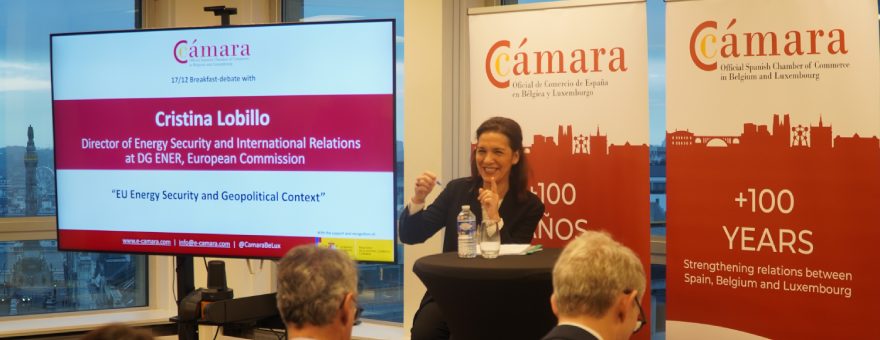
Cristina Lobillo analyses the intersection between international relations, geopolitics, and energy policy in the European Union
Last Wednesday, 17 December, the Official Spanish Chamber of Commerce in Belgium and Luxembourg organised a breakfast debate with Cristina Lobillo, Director for Energy Security and International Relations at DG ENER (European Commission). During the event, entitled “EU Energy Security and Geopolitics”, Ms Lobillo highlighted the close interconnection between international relations and European energy policy, and how each influences the other.
The event opened with welcoming remarks by the President of the Chamber, Mr. Pablo López-Alvarez, who thanked the speaker for her participation and underlined the relevance and timeliness of the topic. Ms Lobillo then delivered an insightful presentation comparing the energy (and geopolitical) models of major global powers. She outlined how countries such as the United States and China understand their energy policy, and how these approaches intersect with their broader geopolitical ambitions.
She contrasted these models with that of the European Union, which is currently pursuing a decarbonisation strategy while seeking to maintain its competitiveness. Finding the right balance between these two objectives, Ms Lobillo noted, is a key challenge for the EU.
The discussion also covered critical issues such as the debate surrounding nuclear energy, the European Union’s dependencies on energy and critical raw materials, and imports of Russian gas and oil in the context of the invasion of Ukraine. Ms Lobillo framed her intervention around two central ideas: Europe’s path towards strategic autonomy, and the overarching goal of EU energy policy, namely to ensure a secure, affordable, and sustainable energy supply for European households and businesses.
Following the presentation, a Q&A session was opened, during which the active participation of professionals from a wide range of sectors led to a rich and engaging debate. Topics addressed included the potential implications of a future peace agreement in Ukraine for the work of DG ENER, as well as more technical questions related to European regulations and legislation.
