Webinar on “Spanish scientific diplomacy – successful collaboration between Spain and Belgium in the field of biotechnology”

Last Wednesday 9 September, the Cultural and Scientific Department of the Spanish Embassy in Belgium, and the Official Spanish Chamber of Commerce in Belgium and Luxembourg, with the collaboration of the Centre for the Development of Industrial Technology (CDTI) and the Spanish Office of Science and Technology (SOST) organised, in a special edition of the “Mediodias de la Embajada”, the second event in the framework of the Spain means Innovation programme. This webinar was entitled “Spanish scientific diplomacy – successful collaboration between Spain and Belgium in the field of biotechnology”.

As part of the programme of scientific diplomacy and dissemination of science, technology and innovation of Spain in Belgium, this webinar examined the innovation and business opportunities between Spain and Belgium in the field of biotechnology, based on the experience of the Spanish company Minoryx Therapeutics, as an example of good practice in collaboration in the biotechnology sector between the two countries.

Minoryx Therapeutics is a biotechnology company focused on the discovery and development of new therapies for severe genetic diseases of the central nervous system, which recently opened a subsidiary in Wallonia near the city of Charleroi (Belgium).
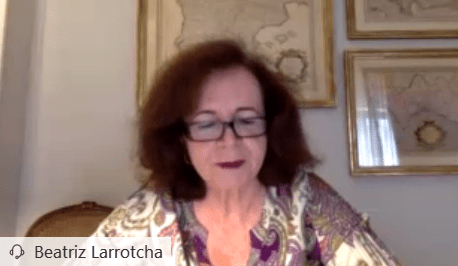
The event began with a welcome speech by H.E. Beatriz Larrotcha Palma, Spanish Ambassador to the Kingdom of Belgium, who summarised the enormous commitment to innovation and scientific research shared by both countries and thanked the speakers and attendees for their presence at this webinar. blankWilly Borsus, Vice-President of Wallonia, Minister for the Economy, Research and Innovation, Digital Technology, Agriculture, Urban and Regional Planning, IFAPME and Competence Centres, then presented the many benefits of the Wallonia region in the field of research for the technology sector.
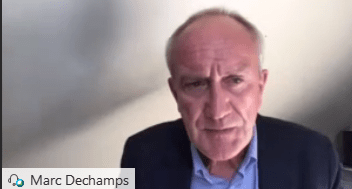
After the words of welcome, the round table was held, moderated by Frédéric Soumois, a journalist specialising in the health and blankscientific field from the newspaper Le Soir. Marc Martinelli, CEO of Minoryx Therapeutics, began by explaining the basis of their current research into rare diseases of the central nervous system, as well as detailing the benefits of the Belgian market in the sector based on his current experience with the company’s subsidiary opened near the city of Charleroi (Wallonia). He was followed by Josep Samitier, blankdirector of the Biotechnology Institute of Catalonia, and Marc Dechamps, director of international affairs for the BioWin cluster, who both gave their views on the benefits of biotechnology for improving the health sector, emphasising the advantages of Spain and Belgium in the sector.

The round table ended with Marina Martinez, H2020 Programme Officer at the Centre for Technological Development and Industry (CDTI), who briefly presented the numerous support and promotion mechanisms at European (Horizon 2020) and national level for companies in the biotechnology sector.

Finally, throughout the question time, participants had the opportunity to present their comments and questions on numerous issues of interest. From the Spanish Official Chamber of Commerce in Belgium and Luxembourg we would like to thank all the participants and the speakers at the event for their participation.
Organized by:

blank      blank     blank    blank    blank

In collaboration with:
blank      blank      blank

Control of the sanitary situation, the beginning of the school year for all and future perspectives

The National Security Council, enlarged to include the Ministers-Presidents, met on Thursday 20 August to assess the epidemiological situation and identify measures that should be expanded and those that could be relaxed.

In addition to stabilizing our health situation, the measures in place in recent weeks were aimed at immunizing the beginning of the school year, that is, ensuring that the circulation of the virus is sufficiently controlled so that all children can return to school.

Therefore, all students will be able to return to school, at all levels of education, based on the “code jaune” established by the communities. As a reminder, the code jaune refers to a situation where the presence of the virus remains active but controlled. This system will allow a normal 5-day school week, provided that certain health measures are observed, such as the compulsory wearing of masks for students over 12 years of age and for teachers, and the suspension of certain extracurricular activities in secondary education.

In addition to this common regime, in communes where contamination peaks are observed, the change to an orange colour code will be decided by the Ministers of Education. This colour coding involves adjustments, such as reducing the number of school days for the second and third levels of secondary education. Parents, children and teachers will be informed by the schools.

At the higher education level, given the late start of the school year, consultations are still ongoing to harmonize the rules that will be applied on student campuses.

From 1 September and for a period of one month:

  • The social bubble of 5 persons, i.e. persons with whom citizens have close contacts, will continue to apply, under the same conditions as in August. Contacts within safe distances are still limited to 10 people at a time.
  • The general measures concerning social contacts are difficult to maintain in the long term. We must be able to move from crisis management to long-term risk management dynamics. We have to be able to reinvent the way we maintain social contacts in a sustainable way. In order to do this as normally as possible, while preserving everyone’s health, the experts at Celeval – with the support of other specialists such as psychologists – have been asked to give priority to this issue.
  • Receptions after funerals can be held with a maximum of 50 people, in accordance with the rules that apply to the hotel and catering sector. The next National Security Council will be interested in the question of a possible relaxation of the rules for receptions in general.
  • Regarding shops, it will now be possible to do shopping in pairs (these two people can be accompanied by minors living under the same roof or by a person who needs assistance) and this without any time limit. It goes without saying that everyone’s sense of responsibility is called upon to avoid the effects of crowds. Unlike the other measures valid from 1 September, this measure will apply from 24 August.
  • Concerning spectators, the maximum number of people admitted to an audience – at sporting events, theatres, cultural activities, places of worship, congress halls or auditoriums – will be increased to 200 people inside and 400 people outside. The use of a mask remains mandatory, as does compliance with safety standards and protocols. In order to give more flexibility – where safety rules are respected – to professionals, it will be possible to derogate from this rule after examination by the mayor and authorisation by the competent ministers.
  • Persons who have become physically separated in recent months because they come from different countries and who provide evidence of a lasting relationship but are not married will be able to cross the border as from 1 September. These persons will be subject to the same testing and quarantine rules as others.

With respect to travel, it was recalled that, since 1 August, any person arriving in Belgian territory after a stay abroad of more than 48 hours must fill in the passenger tracing form, which makes it possible to know where the traveller has been. In addition:

  • Anyone returning from a red zone should be tested and remain in quarantine even if they show no symptoms.
  • If the person returns from an orange zone, this is a recommendation. However, this recommendation should be taken seriously, especially if the person returning from an orange zone has had risky contacts.
  • In addition, citizens are asked to actively participate in tracing contacts with regional call centre managers.

The evolution of the health situation will, as always, be closely monitored and a new National Security Council will be organised next month. The long-term objective is to move from crisis management to a long-term risk management dynamic.

New Board of Directors of the Spanish Charity Assotiation in Belgium

The SEBB is a charitable institution which, set up at the beginning of the 20th century, serves, as far as it is able, the needs, both material and moral, of the Spanish people in Belgian territory.

The Board of Directors, which governs the activities of the SEBB, is made up of volunteers of Belgian and Spanish nationality.

The Honorary Presidency is held by the Ambassador to the Kingdom of Belgium.

In her capacity as Honorary President, the Ambassador, Beatriz Larrotcha Palma, convened the General Assembly which, meeting on 16 July, dealt, as a matter of priority, with the renewal of the Board of Directors.

For reasons of age, the following resigned from their posts: the President, Carmen Gómez de Olea de Felsenhart, the Treasurer, Nieves Calatayud de Glanard and the Judge, Hubert Preiser.

The Assembly elected María José Cano Alemán as President. Manuel Menéndez Barrero, a member of the Chamber’s CA, continues as Vice President. Our President, Juan Rodríguez-Villa Matons, joins the Board of Directors as Treasurer.

The Chamber of Commerce, as the spokesperson for a significant part of Spanish civil society in Belgium, expresses its admiration and gratitude to the three outgoing members for the dedication, commitment and generosity that, over several decades, have made it possible to alleviate the economic and moral problems of Spaniards in need.

Comercial opportunities in Belgium and Luxembourg after COVID-19

COVID-19 has had a very different impact in Belgium and Luxembourg marked by a light lockdown and strong determination by public administration to support its business and protect employment. This health crisis has been without any doubt a mayor disruptive factor that highlighted some existing tendencies already putting in place in both markets. That is why, despite the limited uncertainty, some opportunity window seem to be opening in the next months in Belgium and Luxembourg in the upcoming months making them two very interesting destinations for internationalization strategies for Spanish companies.

In this context, the Chamber has developed a series of collaborations with various Spanish territorial chambers to present the Belgian and Luxembourg markets to Spanish companies. In particular, presentations were made for the Chamber of Commerce of Pontevedra, Vigo and Villagarcía de Arousa, Madrid Network and the Chambers of Commerce of Zaragoza and Mallorca. Throughout these webinars, the main sectors of interest in each country were presented and a series of recommendations were given to companies interested in internationalizing their product or service.

The internationalization of companies will be a key element for their survival in the post-Covid situation.

During the months of September and October, the Chamber is planning new presentations.

These are the dates:

  • In collaboration with the Chamber of Commerce of Gran Canaria, 17th September at 11:00
  • In collaboration with the Chamber of Commerce of Huelva, September 29th at 11:00
  • In collaboration with the Chambers of Avilés, Gijón and Oviedo, 30th September at 11:00
  • In collaboration with the Chamber of Commerce of Huesca, October 2st at 9:00
  • In collaboration with the Chamber of Commerce of La Rioja, 6th October at 9.30am.

The Interinstitutional Concertation Committee extends the obligation to wear a mask in Belgium

The Interinstitutional Concertation Committee held a meeting on Thursday 9 July in the presence of the members of the Exit Strategy Expert Group (GEES). On this occasion, the members presented a new report to the political leaders in which they recommend the extension of the mandatory use of the mask. They agree with the opinion issued by the Superior Council of Health. On this basis, the Interinstitutional Concertation Committee decided to extend the compulsory use of masks, therefore following the new recommendations of the GEES.

As a reminder, the use of the mask was already compulsory in a limited number of situations, such as in public transport or in the exercise of a profession with close contact with the public (hairdressing, etc.) for instance.

From Saturday 11 July, the use of the mask will also be compulsory:

– in shops and shopping centres;

– in cinemas, theatres, concert halls, conference rooms, auditoriums, places of worship, museums, and libraries

This list could change over time, depending on the epidemiological situation in Belgium. The use of masks is still recommended in other situations.

Citizens who do not respect the obligation to wear a mask in the cases mentioned above may be subject to penal sanctions as stipulated in the ministerial decree. In addition, this decree will specifically consider the possibility to close establishments which repeatedly violate the current rules.

As a reminder, the mask is not compulsory for children under 12 years old. Particular provisions are also made for persons who cannot wear a mask for medical reasons.

A National Electronic Safety Council will ratify this decision on Friday 10th.

The authorities recall and insist that the mask is an additional protection that does not dispense with the six “golden rules” of deconfinement, namely:

– Apply hygiene measures such as regular hand washing;

– Encourage open-air activities;

– Pay particular attention to vulnerable groups;

– Maintain a safety distance of 1.5m as far as possible;

– Limit the number of contacts (15 people per week);

– Limit the size of meetings (15 people).

These six golden rules remain the first line of defence against the virus.

The Chamber presents the Erasmus program for Young Entrepreneurs in the Midis de l’emploi of the ULB

On July 3 the Chamber participated in the Midis de l’emploi, a series of workshops organized by the Université libre de Bruxelles with the aim of informing their students about the different employment options after their studies.

During the workshop entitled “Is the Erasmus for Young Entrepreneurs program for me?“, the Chamber had the opportunity to discuss about entrepreneurship and entrepreneurial skills with the students, in addition to presenting this mobility program for entrepreneurs in Europe.

The workshop was also attended by Emanuel Lemus-Monge, a young entrepreneur who registered through the Chamber who will begin his exchange in Spain in the coming days.

The students were very interested and presented their questions to the manager of the project at the Chamber, Soraya Bravo, who gave them individualized recommendations for their exchanges abroad.

Infoday about the PICE Mobility Plan

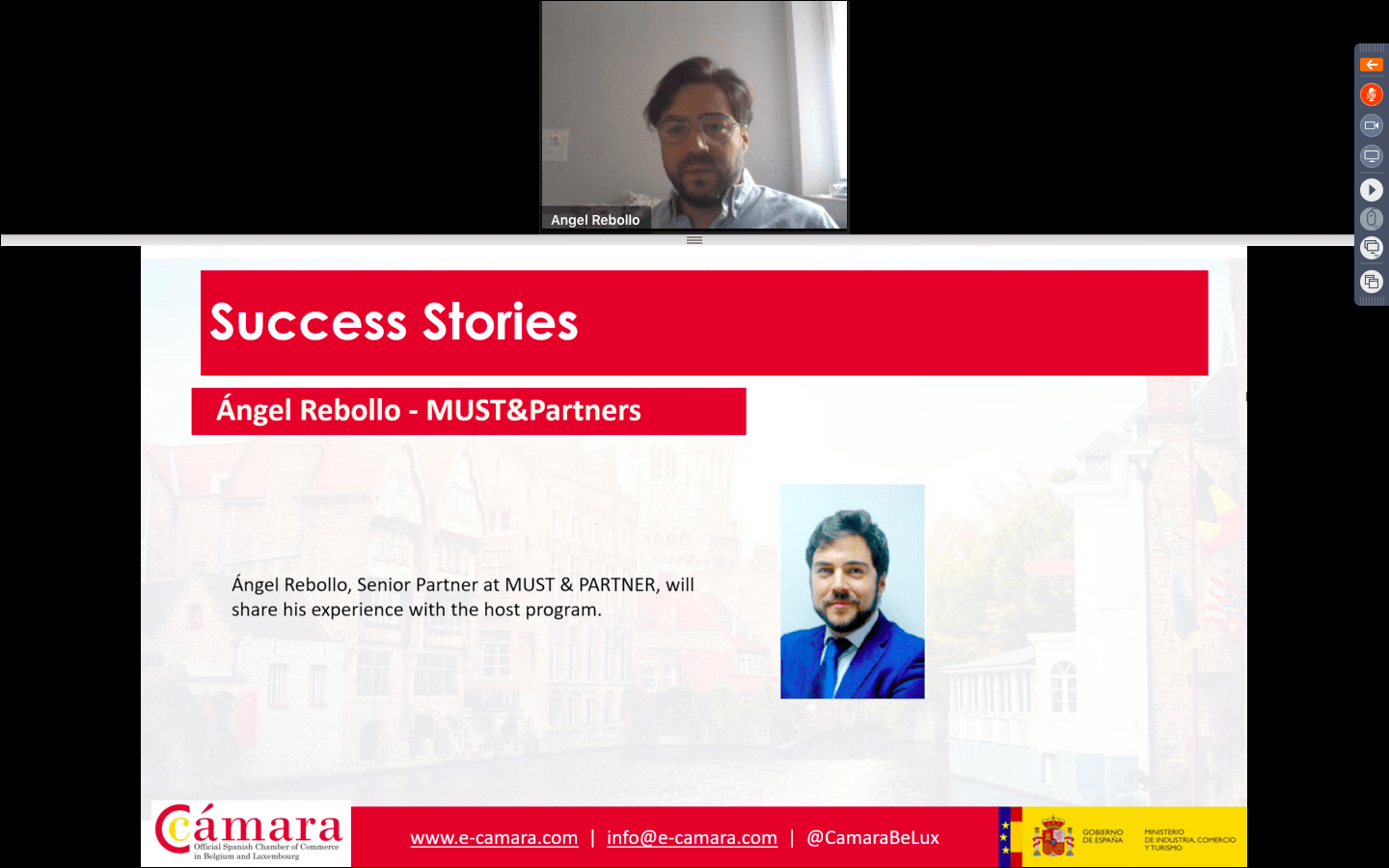
Last June 30th, the Official Spanish Chamber of Commerce in Belgium and Luxembourg as the new local contact point for the PICE Mobility Plan in BeLux, organized an online Info Day about the program.blank

The Mobility Plan is a program created by the Spanish Chamber of Commerce’s Network and co-financed by the European Social Found which is part of the Spanish National System of Youth Guarantee and offers both personal and professional development opportunities through internships or employment contracts in companies from the European Union. 

During this Infoday online we had the participation of Ángel Rebollo, from our company member Must&Partners who told his experience as a successful story in this mobility plan to all the participants.

Thanks to this program we can help Belgian companies to find young and motivated talented professionals with the education and experience adapted to business’ needs. 

If you are interested to incorporate new trainees in the upcoming months you would like to have more information about it please send an email to info@e-camara.com

blank

Launch of phase 4 de-escalation, starting July 1st in Belgium

Press release by Sophie Wilmès, Prime Minister

The National Security Council extended with the Ministers-presidents of the regions, agreed for a transition to phase 4 of the de-escalating since July 1st, based on the agreement of the GEES experts that is based on the good evolution of the epidemiological situation.

The six golden rules are still in force:

  • Respect for hygiene rules.
  • Prioritize outdoor activities.
  • Take extra precautions for those at risk.
  • Respect for safety distances.
  • The “extended bubble” rule that increases from 10 to 15 different people per week in addition to the co-living. As a reminder, this right is individual.
  • Group activities cannot exceed 15 people, children included. This applies to all unsupervised meetings, regardless if they take place at home or outdoors.

It will now be possible to open under certain conditions:

  • Pools and wellness centers.
  • Amusement parks and indoor playgrounds.
  • Theatres and cinemas.
  • Casinos and game rooms.
  • Conference rooms.
  • Reception and party rooms with a maximum of 50 people.

Among the conditions is the application of protocols. In addition, the general rules that are already in force for other activities will be applied, such as the mandatory respect of safety distances, the establishment of time slots and crowd management, the cleaning of infrastructure and the use of mouth masks, which continues to be highly recommended.

Activities that cannot be restarted at this stage:

  • Nightlife activities such as disco clubs.
  • Massive events.

However, it will be possible to organize activities from July 1st in front of an audience, under certain conditions established in the protocols.

For regular events organized in permanent structures such as theaters, cinemas, galleries, congress halls, protocols will be drawn up with competent ministers and experts from GEES.

For specific events in the public space, an online tool will be available on July 1st and will serve as a reference for local authorities in granting authorizations for these events. Specific rules should also apply.

For all these events, there is a capacity limit set at:

  • 200 people inside.
  • 400 people outdoors.

This capacity limit will be re-evaluated in August to 400 people indoors and 800 outdoors maximum if the health situation allows it. An exception can be requested for permanent infrastructure with a public sitting to exceed this limit, respecting health regulations.

The maximum number of outdoor participants will also apply to demonstrations. These should always be subject to a request for authorization from local authorities. In any case, they must always be static and take place in a place where safety distances can be respected.

At the same time, in addition to the resumption of these activities, certain protocols will be relaxed as of July 1st:

  • Possibility of going to the stores with people from your contact bubble and without time limitation. The safety distance will continue to apply.
  • Elimination of the limit on the number of positions for the markets. Health protocols and regulations must continue to apply.

With respect to the next National Day, it was decided that the traditional military and civil parade would take another form exceptionally to meet health standards. In fact, different artistic performances in symbolic places will highlight our country and its artists and will be broadcast on television. Detailed communication will be made later on this topic.

On the longer-term perspective, the start of the school year is already in full swing. The ministers of education, in collaboration with the GEES experts, have established a colour code system that indicates how the school should be organized according to the health situation. Education ministers will explain the plan in more detail at a press conference.


Source: Info-coronavirus.be

Virtual round table on “The tourism sector in post-Covid-19 Europe: Challenges and opportunities”

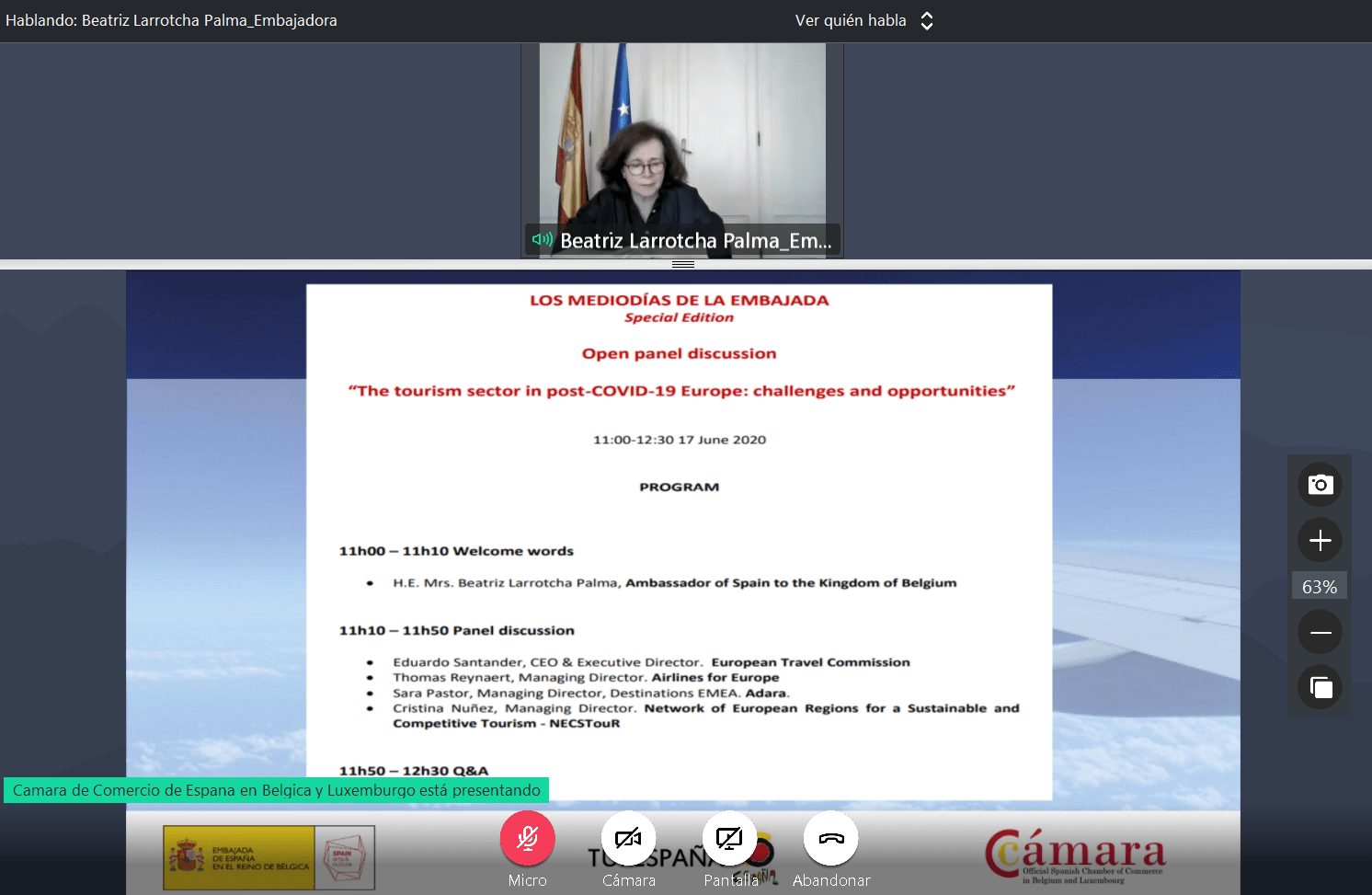
On Wednesday, June 17th, from 11:00 to 12:30, the Embassy of Spain in the Kingdom of Belgium and the Spanish Tourist Office in Belgium, in collaboration with the Official Spanish Chamber of Commerce in Belgium and Luxembourg, organized a virtual round table on “The tourism sector in post-Covid-19 Europe: Challenges and opportunities”, a special edition that is part of the Mediodías de la Embajada events.blank

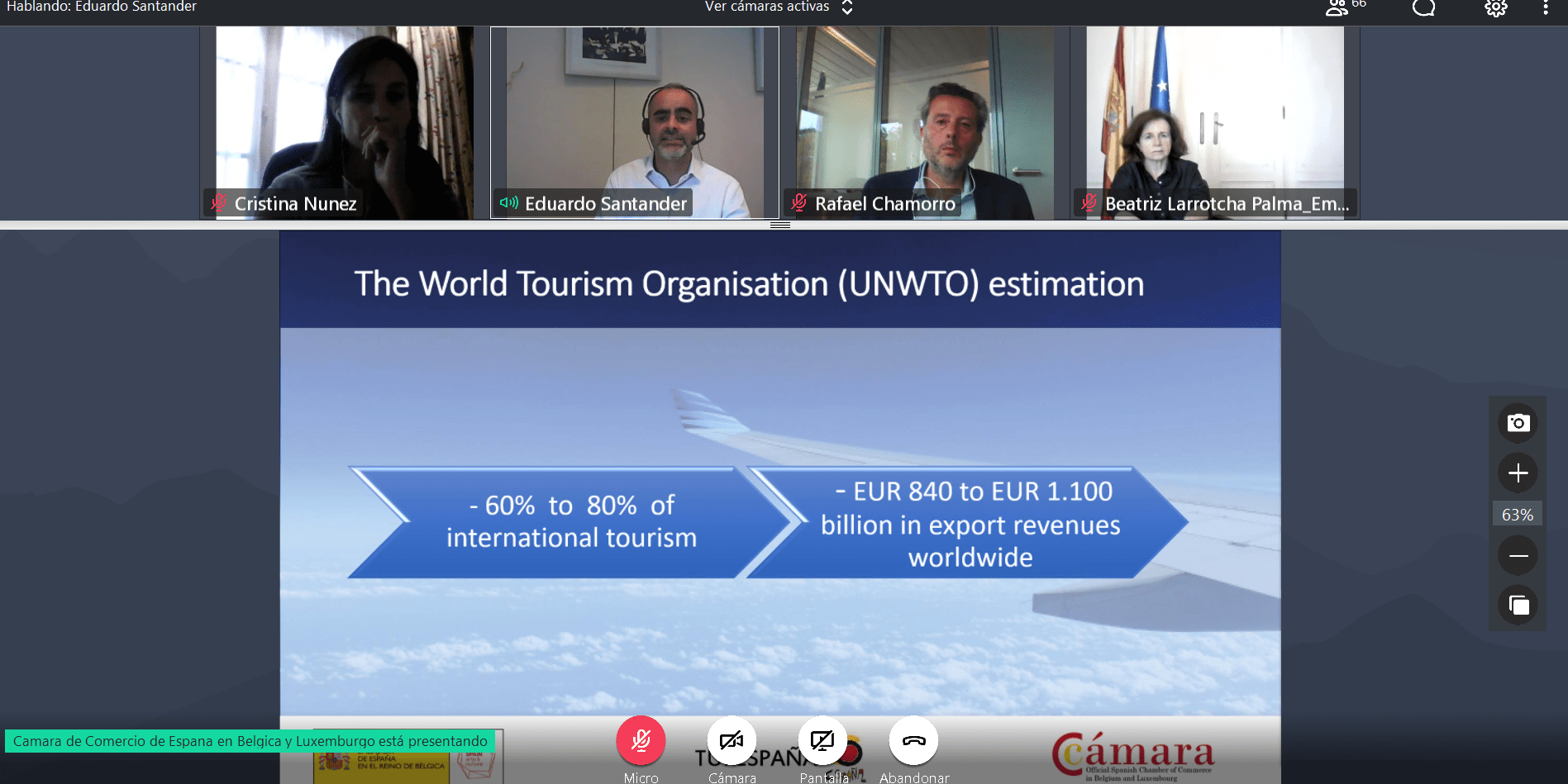
The debate was chaired by Rafael Chamorro, Director of Spanish Tourism Office in Belgium, and featured H. E. Ms. Beatriz Larrotcha Palma, Ambassador of Spain to the Kingdom of Belgium. For the roundtable the speakers were Eduardo Santander, CEO & Executive Director of European Travel Commission, Thomas Reynaert, Managing Director of Airlines for Europe, Sara Pastor, Managing Director, Destinations EMEA of Adara and Cristina Nuñez, Managing Director of Network of European Regions for a Sustainable and Competitive Tourism – NECSTouR.

The welcome words were given by H. E. Ms. Beatriz Larrotcha Palma, Ambassador of Spain to the Kingdom of Belgium, stating the importance of tourism for Spain and Europe and the great effort put in place by Spanish authorities to restore trust in Spain as a safe destination. The Ambassador also thanked all the organizers for the webinar as well as to all the attendants for their interest.

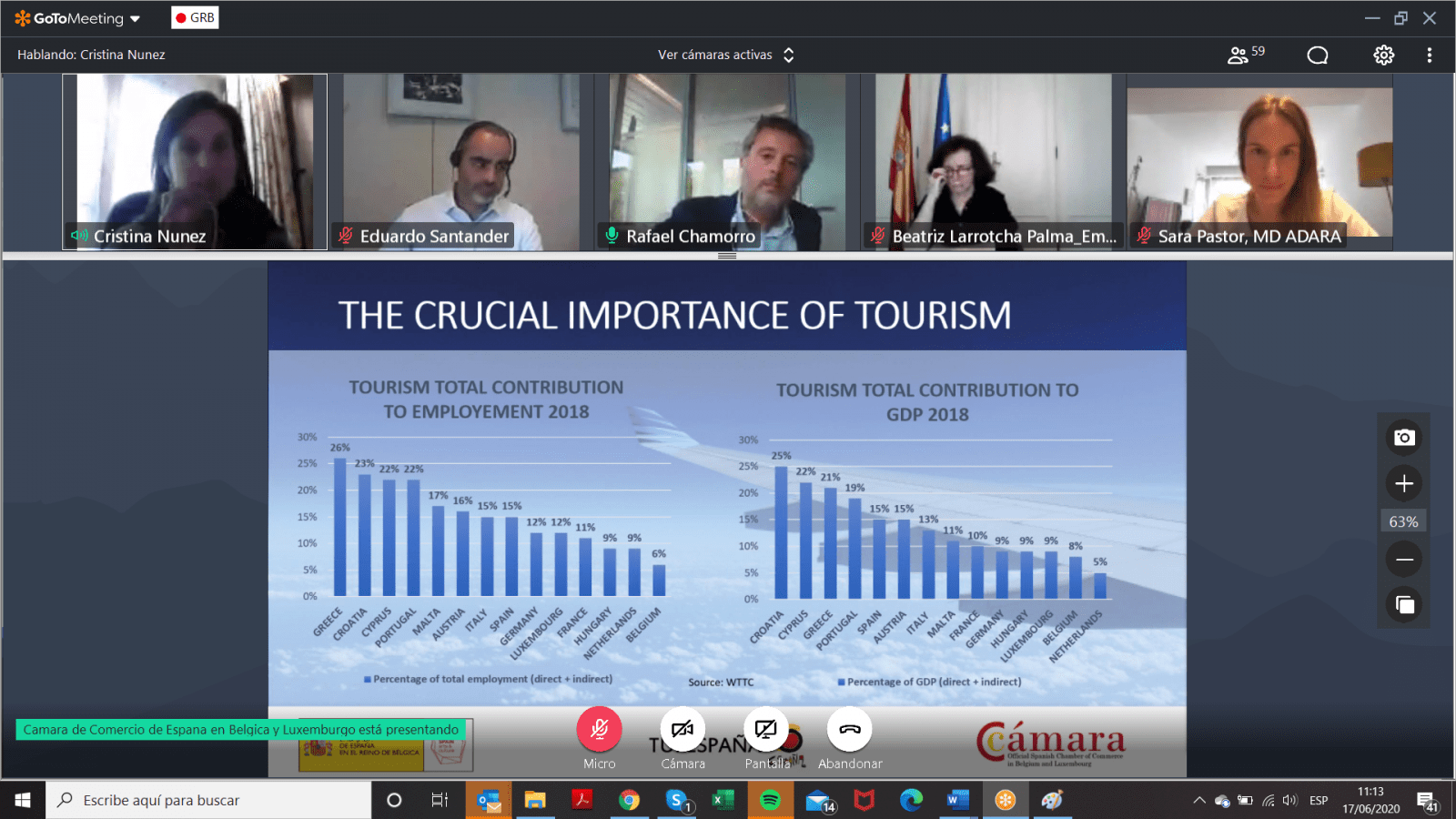
Following the welcome words, Rafael Chamorro, Director of Spanish Tourism Office in Belgium, Presented all the speakers and opened the roundtable by giving some key numbers about the critical importance of tourism sector not only for Spain but also for Europe as around 10% of EU’s GDP depends directly from this sector. Despite some disparities between EU countries, the economic importance of tourism in terms of employment and growth make compulsory for Europeans to be able to travel again with open borders.

blankDuring the debate, Eduardo Santander, CEO & Executive Director of European Travel Commission, insisted in the fact that this crisis might be the perfect opportunity to rethink tourism once the health crisis is over. As some symptoms of the lack of sustainability arise earlier than the COVID-19 crisis, it is the perfect time to think in a future of tourism with a green mark that gives opportunities to regions that traditionally were not receiving much tourism (España vaciada) rather than coming back to unsustainable massified destinations.

Thomas Reynaert, Managing Director of Airlines for Europe, gave his impressions on how severely this crisis has affected the airlines and how they are taking measures to recover from it. Airlines will also be key for the development of the green deal strategy in the near future in addition to some harmonization policies needed in the sector at the EU level. The speaker also highlighted the importance of individual responsibility in flights as long as the health crisis lasts even if the safety is completely ensured thanks to air technologies on planes.

Sara Pastor, Managing Director, Destinations EMEA of Adara, shared with the audience a general picture on how the crisis has been faced by the sector and how the data shows we are starting to rise the curve of reservations as Europeans have not lost their will to travel. This current scenario means that the right strategy to attract the tourists can make the difference for all actors in the sector (regions, hotels, airlines, etc.). A common strategy Europe-wide is needed to prevent comparative advantages (and disadvantages).blank

Cristina Nuñez, Managing Director of Network of European Regions for a Sustainable and Competitive Tourism – NECSTouR, highlighted the importance of regions in this sector recovery as it is crucial for them to keep attracting public attention by focusing on their strong points. She also agreed that this crisis can be a huge boost for rural areas or regions that traditionally were not among top destinations, therefore it is important to generate trust in the tourist that are looking for this non-massified destinations.

During the Q&A session, participants were able to raise questions of their interest. Some topics covered during this session were the need to restore trust in tourism or the opportunities given to rural areas.


Organized by:
In collaboration with:
blank      blank
blank

Agreement reached in limited cabinet: here are the new measures in the federal aid plan

On Friday night, an agreement was reached within the “superkern”, the Federal Government and the ten parties that support the special powers destined to fight Covid-19, after several hours of meeting. The text was not validated by the N-VA. The Flemish nationalist party did not sign the joint statement sent shortly before 22:00.

“Today’s agreement reinforces the social and environmental measures taken last week. The nonsense proposals pushed by the N-VA have been completely rejected”, Ecolo co-chair Jean-Marc Nollet said on Twitter.

On June 6th, the ten parties approved a first set of measures. Later it was agreed to identify in a second step what could complement this system. That was the work that was carried out during the meeting this Friday.

The new support measures, protagonists of the agreement can be classified into two categories, indicates the press release signed by the government parties (MR, Open Vld and CD&V), with the support of the Socialists (PS and sp.a), environmentalists (Ecolo-Groen), CD&V, cdH and Défi.


The first category refers to investment support.

  • The superkern has decided to establish a new temporary Covid-19  tax shelter system until the end of the year, open to all SMEs that have been affected by the Covid-19 crisis.
  • An investment deduction increased by 25% is provided for investments made between March 12th and December 31st, 2020.
  • The nine parties have also decided to increase the deductibility of expenses related to the organization of events and catering from 50 to 100% until December 31st.
  • The superkern has also decided to suspend the payment of VAT from December 2020 and increase from 10 to 20% the share of net income that can benefit from the reduction of subsidy taxes.
  • At the same time, the tax reduction for donations made in 2020 to approved institutions will decrease from 45 to 60%.


The second category refers to the organization of work, according to the statement.

  • The nine parties have decided to create adapted Corona unemployment, which consists of a transition between temporary unemployment due to the force majeure Corona and classic economic unemployment. This transitional economic unemployment can be used if the company shows a 10% drop in its turnover. The worker will follow two days of unemployment training per month and will continue to receive 70% of their last maximum salary.
  • It was also decided to offer companies in restructuring or in difficulties the possibility of reducing working hours pending the resumption of normal activity and to avoid layoffs, either through a collective reduction in working time, either through the time credit system, or through the time credit at the end of the degree, whose accessibility will be reduced from 57 to 55 years.
  • In addition, the Corona parental leave will run until September 30th with a subsidy increased to 150% for single parent families and families with a child with a disability.
  • It was also decided to facilitate the reimbursement of the costs incurred by teleworkers, up to a maximum of 127 euros per month.


In addition to these measures, an agreement was also reached to release funds of 100 million euros for the CPAS to be dedicated to people in difficulties in order to extend the benefit of the social measures decided during the previous meeting to a more public comprehensive, especially from the point of view of energy poverty. To cover the operating costs linked to an additional workload, the CPAS will receive an additional aid of 10 million euros.


Source: Rtl.be